Source note: Local copy of a Summer Into AI 2026 submission originally published on Substack. Screenshots, video, and audio found in the post body are mirrored locally when publicly accessible; profile and avatar images are intentionally not copied. Read the canonical post.
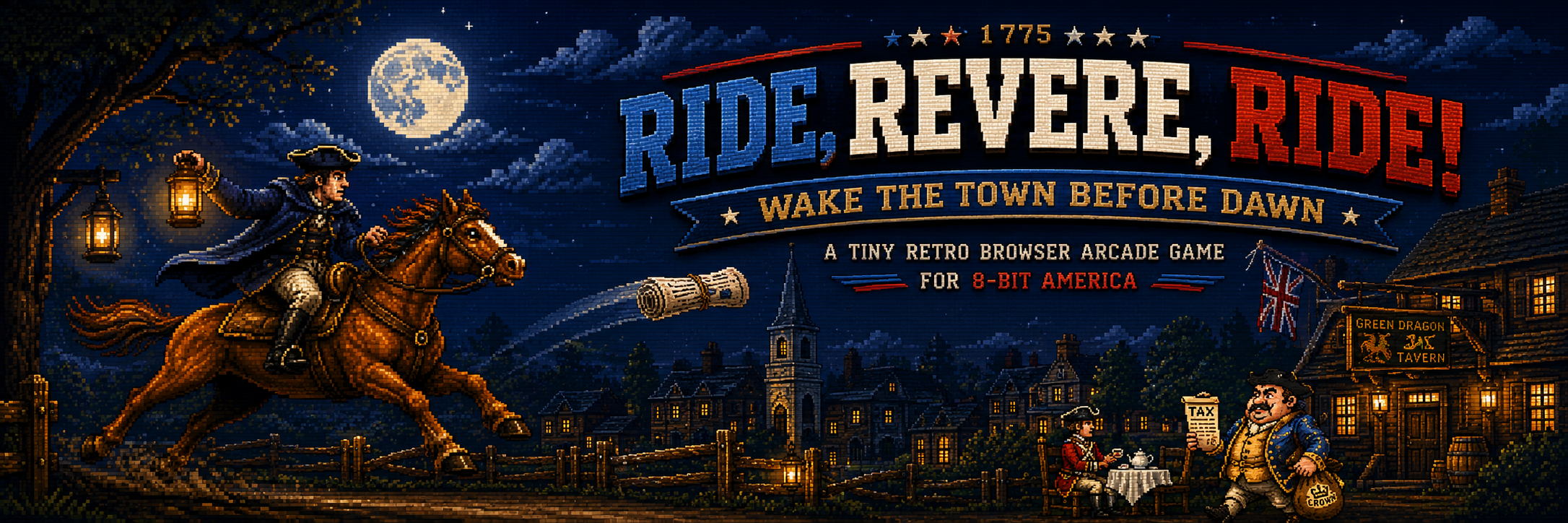
The competition prompt said 8-Bit America, which is a dangerous phrase to hand me because I have ideas for days and very little instinct for leaving well enough alone. A normal person sees that prompt and thinks, “Maybe I’ll make a nice pixel flag.” I see it and immediately have twelve competing concepts fighting in my head like a dumpster diver behind a historical reenactment gift shop.
I will link the competition here.
It did not say, “Create a civic engagement dashboard with beige tabs, a stock photo of fireworks, and a mission statement written by a committee that hates verbs.” It said to build a tiny retro-styled thing connected to America at 250. Something public. Something small. Something playable. Something weird enough to remember after the tab is closed.
So I built a tiny browser arcade game about Paul Revere. It is called:
Ride, Revere, Ride!
You play as Paul Revere riding through the night, throwing warning broadsides, waking the town, dodging Crown hazards, and trying to beat dawn. That is the whole machine. Move lanes. Throw broadsides. Wake buildings. Dodge tax collectors, loyalists, mud, barrels, those evil little bundles, and redcoats having tea in the road. Build combos. Raise the alarm. Beat dawn.
There is no login, no backend, no online leaderboard, and no “future roadmap to reimagine democratic participation,” because I was not about to build an authentication system for Paul Revere. The man is busy. It is just a little arcade toy with a horse, a timer, and an alarm meter. Exactly as the founders intended, probably. It is supposed to be fun. Enjoy the free fun. It is the American way.
Play it
Public demo:
https://bluntforceriot.github.io/ride-revere-ride/
Source code:
https://github.com/BluntforceRiot/ride-revere-ride
It runs in the browser through GitHub Pages. Normal play does not require downloading the repo, installing anything, or performing a midnight candle ritual over npm install. Current build: v0.9.3.
What it is
Ride, Revere, Ride! is a tiny retro browser game. The player rides down a moonlit colonial road with four lanes. Arrow keys or WASD move between lanes. Space throws a broadside, which is basically a founding-era warning flyer with better posture and significantly more urgency.
Buildings can be warned. When hit, they light up, the alarm meter rises, and the score climbs. Hazards cost stamina. Combos multiply score. Dawn ends the run. The game-over screen lets you enter initials for local high scores, because nothing makes a tiny game feel more like an arcade cabinet than putting three letters next to your failure and pretending that was a personality.
The goal was not depth. The goal was “one more run.” It is the kind of game where someone immediately understands what to do, plays for a few minutes, laughs at one object, loses, and hits start again because now they know they can do better. That is the arcade demon. That is the little hand extending from the coin slot.
Why this fits 8-Bit America
This fits Theme 1 because it takes an American memory and turns it into a tiny retro arcade object. America at 250 does not have to be only marble, parchment, brass plaques, and museum-voice seriousness. We have enough solemn laminated placards. We can also have a goofy little cartridge-shaped artifact where a familiar founding-era story becomes a score attack.
The historical idea is Paul Revere’s warning ride. The game version is much dumber, which is why it works. You ride through the night. You throw warnings. You wake houses, taverns, churches, blacksmiths, and militia posts. You dodge Crown hazards and try to raise the alarm before dawn, because apparently the entire fate of the countryside now depends on one guy, one horse, and your ability to not hit a barrel like an idiot.
It uses retro game logic to explore the theme: a simple objective, a countdown, score chasing, local high scores, readable hazards, arcade feedback, old-screen visuals, and a founding-era premise turned into a tiny playable loop. It is not trying to teach the entire American Revolution. Nobody should cite my barrel placement in a history paper, and nobody should form a serious opinion about colonial logistics from those evil bundles. It is trying to make one little piece of American memory playable.
The best hazard is the redcoat tea table
There are royal tax collectors. There are loyalists. There is mud. There are barrels. But the redcoat tea table is the soul of the game, and I am not apologizing for it.
It started as a joke and then became the whole thesis wearing a powdered wig. Two redcoats are just sitting in the road having tea while Paul Revere is trying to wake the countryside before dawn. That is the tone. Recognizable history, filtered through arcade nonsense. A little absurd, but not random.
The Crown is not only chasing you. The Crown is blocking the road with teatime, which is extremely rude and historically spiritually accurate. I do not care if it is not in a textbook. It feels true in the way only the stupidest correct idea can feel true.
What AI did
I used AI as a collaborator, not a vending machine. ChatGPT helped with concept design, enemy ideas, theme framing, art direction, prompt generation, submission strategy, and critique. Codex helped build the Phaser/Vite/TypeScript game, wire the mechanics, integrate assets, fix build issues, clean the repo, prepare GitHub Pages, and package verification receipts. AI image generation helped create visual references and prototype art direction.
But the final work was not “AI made a game.” That sentence is too smooth and therefore suspicious. That is the kind of sentence that walks into the room wearing a blazer and immediately makes me want to check its pockets.
The real version was more like this: AI makes something, I say, “That is close, but ugly.” AI fixes it, and now something else is ugly. I say, “No, remove the yellow box.” AI removes the yellow box, and now the lanterns are yellow boxes. I say, “No, those too.” At one point Paul and the buildings looked slightly translucent, which is not historically supported unless the Revolution had a ghost DLC. At another point, objects were clipping in ways that made the road feel like it had been attacked by invisible scissors.
The game got better when I stopped asking for more and started asking for less. Less visual helper junk. Less fake polish. Less weird AI crop residue. More readable objects. More playable loop. More “fun little game.” It was actually a lot more work than that, which is not how I usually operate AI, but that is also the point of the competition. Use the tools, push the tools, then stand there like the adult in the room when the tools start handing you glowing rectangles and acting like they solved taste.
That is the human part of AI-assisted work. The model can produce options fast. The human still has to say no. Often. Repeatedly. With receipts, screenshots, and increasing suspicion toward anything that looks like debug UI trying to sneak into the final build wearing a fake mustache.
The hard part was not the code
The code mattered, obviously. The build needed to run. The game needed to deploy. GitHub Pages needed to work. Typecheck and build needed to pass. The browser version needed to load cleanly for a normal person who did not wake up planning to debug my colonial horse simulator.
But the hard part was the last five percent of taste. A pretty AI-generated image is not the same thing as a good game asset. A title screen can look great while the gameplay still looks wrong. A helper marker can make something readable, then become the thing that ruins the scene. A glow effect can become a yellow rectangle. A target indicator can become debug UI. A projectile can accidentally look like a cursed Post-it note.
Most of the late work was subtraction. Remove the target box. Remove the projectile box. Remove the oversized halos. Stop the objects from looking like they are being selected in Photoshop. Make the thing feel like a little game, not a graphics experiment wearing a tricorn hat. The rule became: simple but clean beats detailed but weird. That rule applies to more than game art, unfortunately, which is annoying because now I have to keep using it.
What worked
The basic loop worked early and survived the whole build: ride, throw, warn, dodge, score, try again. That was the spine. The trick was not turning it into a fake “platform” because people love doing that now. You give someone a tiny working idea and within three meetings someone is drawing a subscription tier.
The title screen also worked early. It gave the project the right “lost cartridge” feel, like someone found an alternate-universe NES game in a box labeled “American History, But Less Responsible.” The high score board mattered more than expected because it made the game feel like an arcade cabinet instead of a tech demo. Local high scores are enough. I do not need a global leaderboard for my Paul Revere browser game. I am not trying to moderate the initials some guy in Ohio enters at 2 a.m.
The generated audio cues helped too. Even tiny sound feedback makes a browser game feel more alive. A silent browser game can feel like clicking through a haunted museum kiosk. A few bleeps and warning sounds make the thing wake up, which is good because waking things up is literally the job of the game.
And the redcoat tea table worked immediately because some ideas are dumb in the exact correct direction. There is no committee process for that. You either see two redcoats having tea in the road and understand the assignment, or you do not.
What fought back
Visual integration fought back like it had a personal problem with me. The first versions had debug-looking boxes, ghosty sprites, strange halos, and objects that looked like they were floating in the wrong layer of reality. The art was not bad. The problem was that concept art and runtime game objects are different animals, and one of those animals has to survive being thrown down a road at arcade speed.
A concept image is allowed to be dense. It can have mood, smoke, drama, lighting, and fifty little details hiding in the corners. A game object has a harder job. It has to move, collide, read at a glance, and not look like it was cut out with garden shears by a raccoon going through a divorce.
The v0.9.3 browser version is still a prototype, but it now feels like a tiny finished toy instead of a collage of promising parts. That was the target. Not perfect, not bloated, not a fake startup pitch. Playable, readable, public, and finished enough that someone can click the link, understand the joke, and lose to dawn.
What I learned
Small games are not easy. They are unforgiving in a way big systems are not, because a big system can hide bad edges under menus, features, architecture, and a fog machine full of roadmap language. A tiny game has nowhere to hide. If the projectile looks wrong, you see it. If the target cue looks wrong, you see it. If the player is too dim, you feel it. If the hazard is unclear, the game becomes unfair. If the lanterns are yellow boxes, congratulations, you have invented colonial debugging.
The AI helped me move fast, but it also made more artifacts faster. That means the human part became taste, judgment, and refusal. Refusing to add another system. Refusing to leave ugly helper graphics in the road. Refusing to turn a little arcade joke into a giant platform. Refusing to let “almost” become “good enough” just because the build passed.
That was the operator work. Not dramatic. Not mystical. Just the part where you stare at the screen and say, “No, that still looks stupid,” until it finally stops looking stupid enough.
Submission details
Project title: Ride, Revere, Ride!
Short description: A tiny retro browser arcade game where Paul Revere rides through the night, throws warning broadsides, wakes the town, dodges Crown hazards, and tries to beat dawn.
Theme: Summer into AI, Theme 1: 8-Bit America
Public explanation: This Substack post.
Public demo:
https://bluntforceriot.github.io/ride-revere-ride/
Shared code:
https://github.com/BluntforceRiot/ride-revere-ride
Tools used: ChatGPT, Codex, Phaser, Vite, TypeScript, GitHub Pages, AI-assisted reference art, and a lot of human “no, that looks wrong” passes.
Scoring notes: The game is playable in browser. No download is required for normal play. High scores are local browser storage only. The repo is public. The demo is public. The live build is v0.9.3.
Competitor reference: Not claimed yet. I am not going to invent a competitor reference out of powdered-wig air just because bonus points are shiny. If I add one, it will be a real project with a real link, because that is how receipts work and because lying for bonus points is how you end up writing a corporate values statement.
Final scoring packet, for anyone who skipped the fun part
Project title: Ride, Revere, Ride!
Short description: A tiny retro browser arcade game where Paul Revere rides through the night, throws warning broadsides, wakes the town, dodges Crown hazards, and tries to beat dawn.
Theme connection: This fits Theme 1: 8-Bit America because it uses retro arcade logic, pixel-art-inspired visuals, game-like interaction, and a founding-era American memory to create a tiny public artifact connected to America at 250.
Public demo:
https://bluntforceriot.github.io/ride-revere-ride/
Shared code:
https://github.com/BluntforceRiot/ride-revere-ride
Tools used: ChatGPT, Codex, Phaser, Vite, TypeScript, GitHub Pages, AI-assisted reference art.
Scoring notes: The game is playable in browser. No download is required for normal play. High scores are local browser storage only. The repo is public. The demo is public. The live build is v0.9.3.
Competitor reference: Not claimed unless added later with a real receipt.
Final note
In the spirit of the competition, AI helped me write this article. I’ll let you figure out how much of it. This is not a complete history lesson, a textbook, or a civic platform pretending it is going to fix democracy because someone put a rounded button next to the word “engage.” It is a tiny playable arcade version of a familiar American story. The town is asleep, dawn is coming, and the Crown is in the road having tea like absolute lunatics. Throw the broadside. Wake the town.
Original source
Canonical Substack URL: https://safetylast.substack.com/p/ride-revere-ride-i-built-a-tiny-paul.