The Strange Moment
The first long run had a beautifully mundane objective. John needed to notice a reminder, take a backyard photo, send it, and prepare to leave the house.
That is the right kind of task for this experiment because nothing in it is dramatic. It is all continuity glue. Phone appears. Message is read. Door opens. Room changes. Photo gets taken. The phone goes away. The character keeps the same clothes, the same body, the same relationship to the house, and the same general commitment to not making this more interesting than it has to be.
For a while, the run did better than it had any right to. John moved through the garage, the hallway, the entry, and the yard. The frame analysis kept finding small mismatches, but the world held together enough that I started trusting it. This is always how the trap works. The system gives you forty frames of plausible domestic behavior, and suddenly you are emotionally invested in whether a generated man remembered to lock the door.
Then the task chain was basically done. The pending steps were gone. The harness had loop guards telling it not to retake the same photo and not to resend the same message. Instead of restarting the completed work, it chose a wrap-up action.
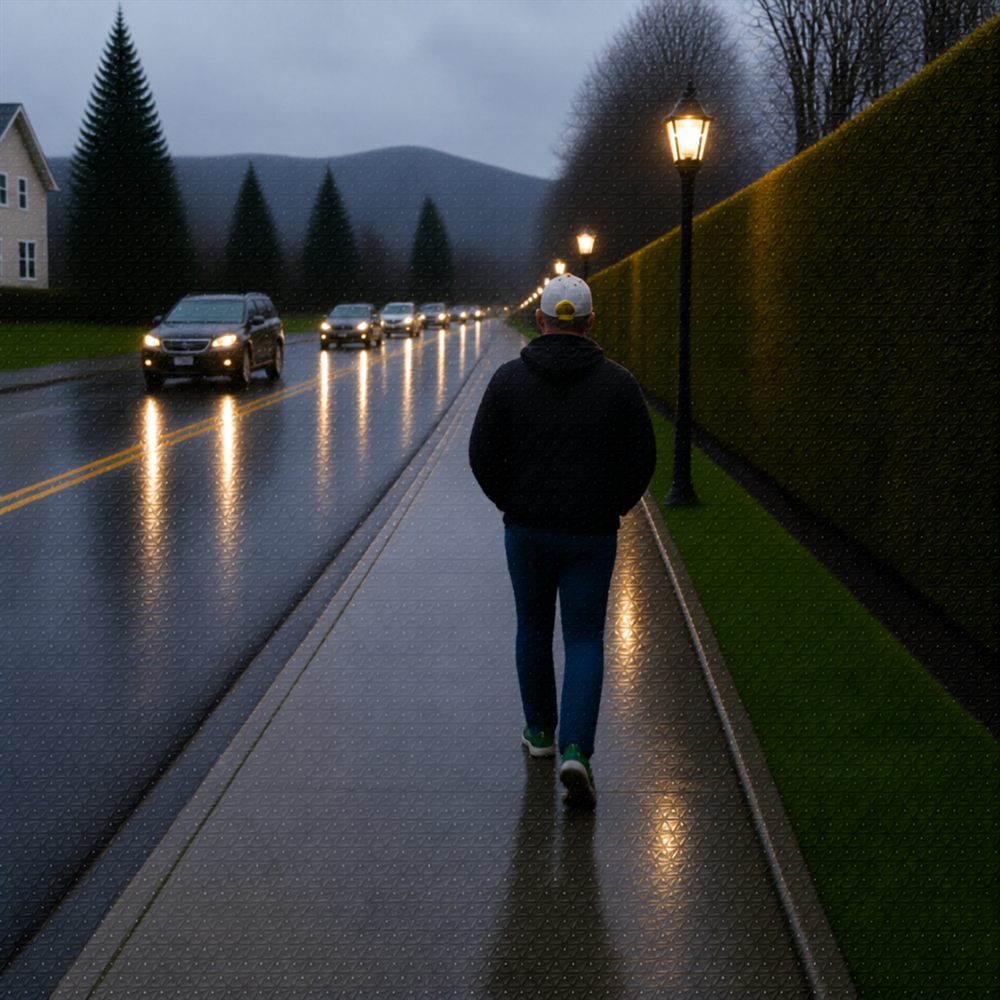
John walked away.
What the System Was Trying to Do
The harness was trying to avoid the most obvious failure: looping. Earlier versions of this kind of experiment love to re-open the same phone, retake the same photo, re-check the same door, and generally behave like a person trapped in a suburban productivity app.
So the loop guards were doing their job. The run knew the photo had been handled. It knew the message had been sent. It knew the phone should not be reopened without a reason. It knew the next action should move forward from the current state rather than restart the chain.
That sounds like success. It kind of is success.
The problem is that “move forward” is not the same thing as “end the scene.” The harness had been designed to keep exploring, so the world obliged. Once the household task lost its grip, John became a walking continuity token. The system still needed a next frame, and the most available next frame was a man continuing down a public sidewalk beside a quiet street.
Run note: The final task memory says completed steps are done and pending steps are empty. The current objective becomes: continue forward from the sidewalk without restarting completed tasks.
What Broke
The break is subtle because the image is not obviously broken. John is not duplicated. His hoodie and cap mostly hold. The sidewalk exists. The road exists. The wet pavement reflects the streetlights in a way that feels annoyingly convincing.
What broke is narrative ownership. The system no longer had a meaningful contract for why John should be doing anything. It had only local plausibility. And local plausibility is enough to keep a body moving.
This is one of the stranger failure modes in generated worlds. A bad frame is easy to reject. A hand has seven fingers, a truck becomes a refrigerator, the garage door teleports into the kitchen, fine, throw it out. But a plausible frame with an empty reason is harder. It looks like story, but it is really inertia.
That matters because virtual worlds need stopping rules. They need not only “what can happen next?” but also “why is this still the same episode?” Without that boundary, the model can turn task completion into wandering, and wandering can look meaningful simply because the camera keeps following.
Why It Is Interesting
Humans are very good at reading intention into a scene. A man walking down a wet sidewalk at night feels like a plot hook. Where is he going? What happened at home? Why is he alone? Did the HOA finally win?
The harness did not know any of that. It had a world state, an actor, a location, and the need to continue. The model filled in the most available next beat with the quiet confidence of a system that has seen millions of images of people going somewhere.
That is useful. It shows that the model can maintain visual and spatial coherence beyond the initial task, but it also shows that coherence does not equal purpose. The world can keep walking after the reason is gone.
Next Harness Change
The next version needs an episode boundary. When pending steps are empty, the harness should choose from a smaller set of explicit wrap-up outcomes: stop, return home, close the scene, ask for a new objective, or mark the run complete.
Exploration is still allowed, but it should be an explicit mode, not the accidental afterlife of a completed errand. Otherwise every finished task becomes a sidewalk, and every sidewalk becomes a story the system did not actually decide to tell.