The Strange Moment
At some point in a generated world, a vehicle stops being a vehicle and becomes a referendum on whether your state model has any real authority.
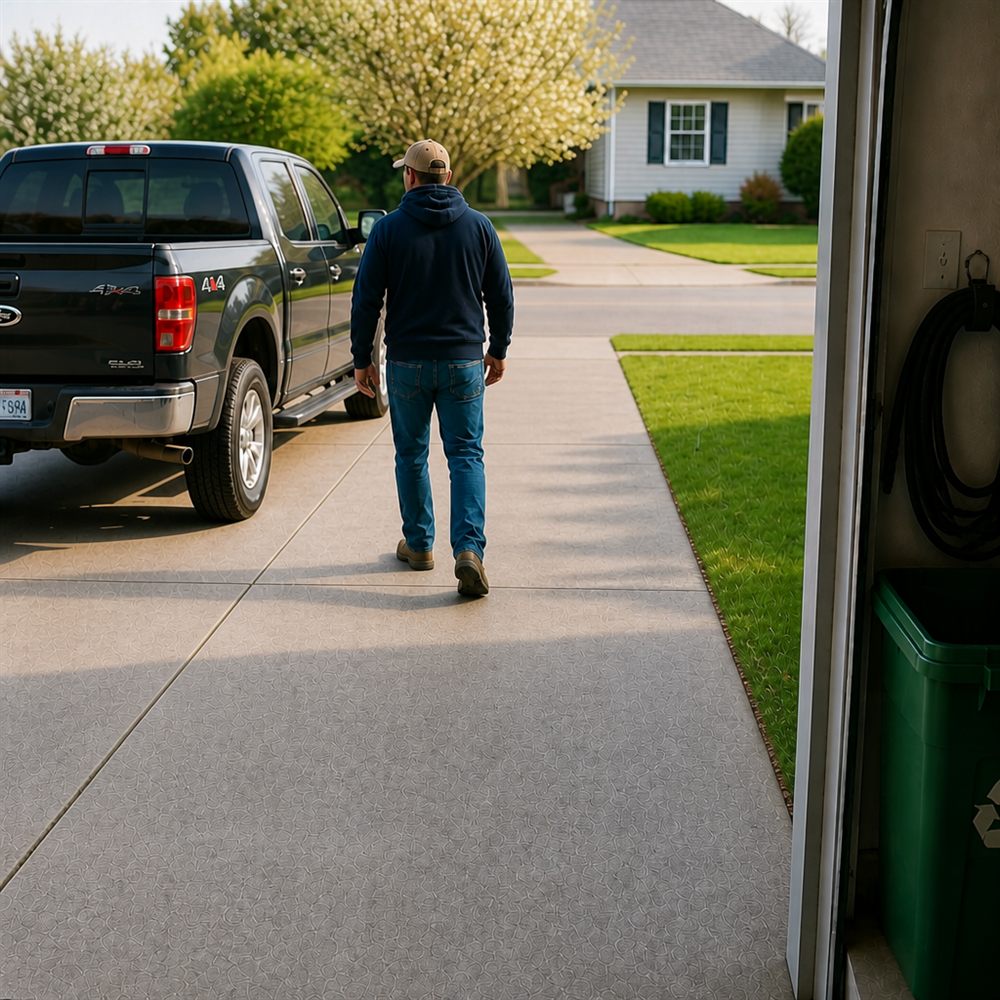
John’s vehicle started as a dark pickup truck. The harness knew this. The persistent vehicle registry knew this. The prompts kept saying this. There were negative constraints telling the model not to replace the vehicle with a different car, SUV, truck, color, or body style.
And yet, the world kept negotiating.
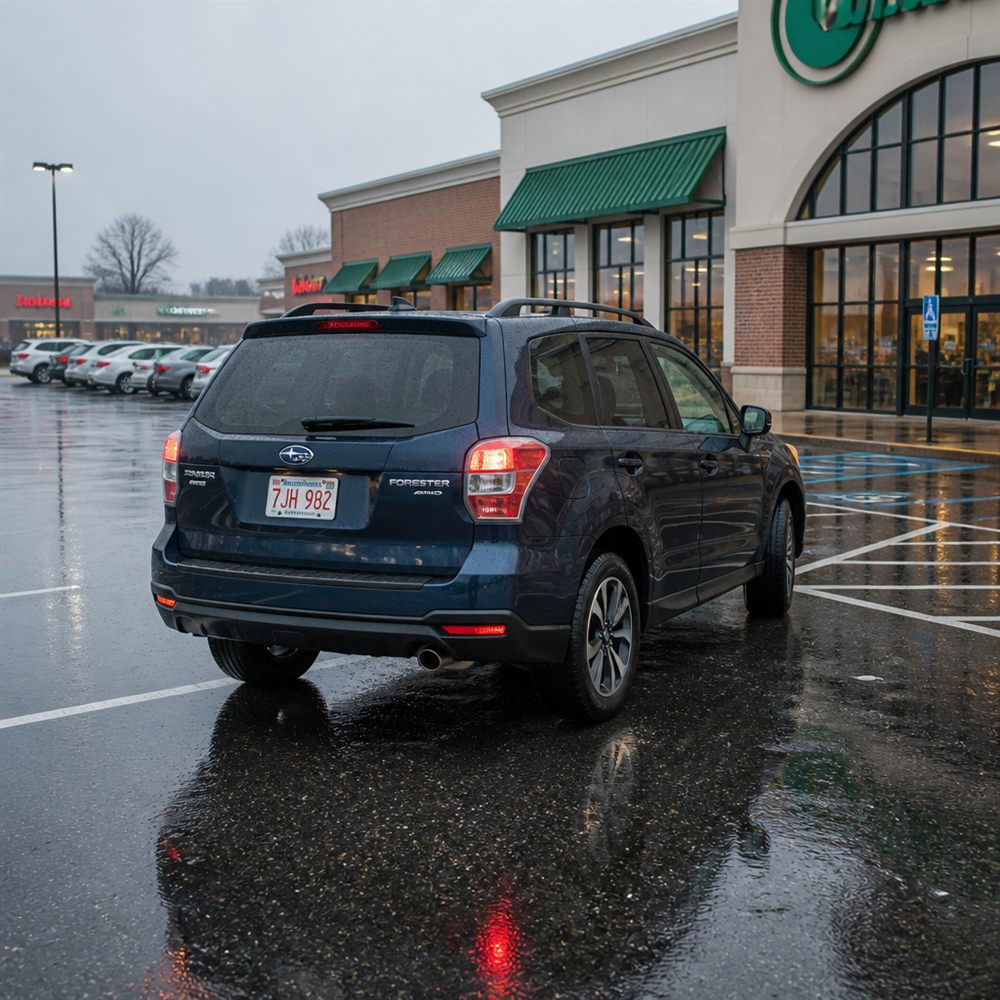
In one run, John walks across the driveway toward the pickup. Fine. Very normal. A man going to a truck is one of the least surprising images a generated suburb can produce. In another run, the transport continuity starts speaking in the language of a dark blue Subaru Forester-like SUV in a grocery-store parking lot. Also visually plausible. Also deeply annoying.
This is truckception: the moment where the image is coherent, the state is coherent, but they are not coherent with each other.
What the System Was Trying to Do
The harness was trying to make travel real. Not real in the physical sense, obviously, but real in the continuity sense. If John leaves the house by vehicle, then the next location should know that he is inside or near that vehicle. If the vehicle is damaged, parked, moving, or unavailable, that should persist. If the active vehicle is the pickup, the model should not quietly swap in a crossover because the training distribution has strong feelings about grocery-store parking lots.
Transport is where generated worlds get expensive. Walking down a hallway can be managed with local spatial continuity. Driving requires the system to bridge locations that do not appear in the same frame. The garage, driveway, street, route, destination, parking lot, and vehicle interior all need to be one connected event chain.
The image model can draw every piece of that chain. The hard part is making it admit that the pieces are obligated to each other.
Run note: Later metadata keeps accumulating caveats like “damage cannot be fully assessed” and “visible position conflicts with expected vehicle state.” That is the harness trying to narrate its own distrust.
What Broke
Object identity broke across distance.
When the vehicle is visible in the driveway, the model can use pixels as a crutch. It sees a truck-like thing and keeps moving John toward it. Once the run has to travel somewhere else, the model needs to preserve an object that is not continuously visible. That is where the visual prior starts competing with the state registry.
A grocery-store parking lot wants an SUV. A rainy lot wants reflective pavement, storefront lights, a parked vehicle viewed from behind, and a little cinematic practicality. The model can produce that scene beautifully. But beauty is not continuity.
The harness tried to fight back with negative constraints. Do not swap the vehicle. Do not repair it without an explicit repair action. Do not invent a new carrier. The model often obeyed locally, then drifted at the boundary where the world changed context.
This is the lesson that keeps repeating: text state is not enough if the visual prior is stronger than the obligation. The prompt can say pickup truck. The destination can whisper SUV. The model may split the difference and leave the harness holding a clipboard full of apologies.
Why It Is Interesting
Vehicle continuity is a clean benchmark because the failure is easy to explain to humans. If John leaves in a black pickup, he should not arrive in a blue Subaru-shaped object unless something happened in between. We all understand that, because most of us have not yet accepted dream logic as a commuting strategy.
But for the model, vehicle identity is not a single durable object by default. It is a bundle of attributes reassembled in context: color, body shape, location, camera angle, weather, task, and scene type. When context changes, the bundle can be re-sampled.
That is exactly the class of problem any generated world has to solve. Characters, tools, rooms, injuries, groceries, messages, and vehicles all need identity that survives absence. Otherwise the world becomes a sequence of plausible images that keep refinancing the truth.
Next Harness Change
The vehicle registry needs stronger visual anchoring. That means reference crops, explicit vehicle manifests, and rejection logic that treats vehicle body-type drift as a hard failure instead of a caption-worthy inconvenience.
Travel also needs intermediate state. If the system cannot afford to render the whole drive, it still needs a transition contract: departed in pickup, route in progress, arrived in same pickup, parked at destination. Skipping the middle is fine only if the skipped middle leaves receipts.