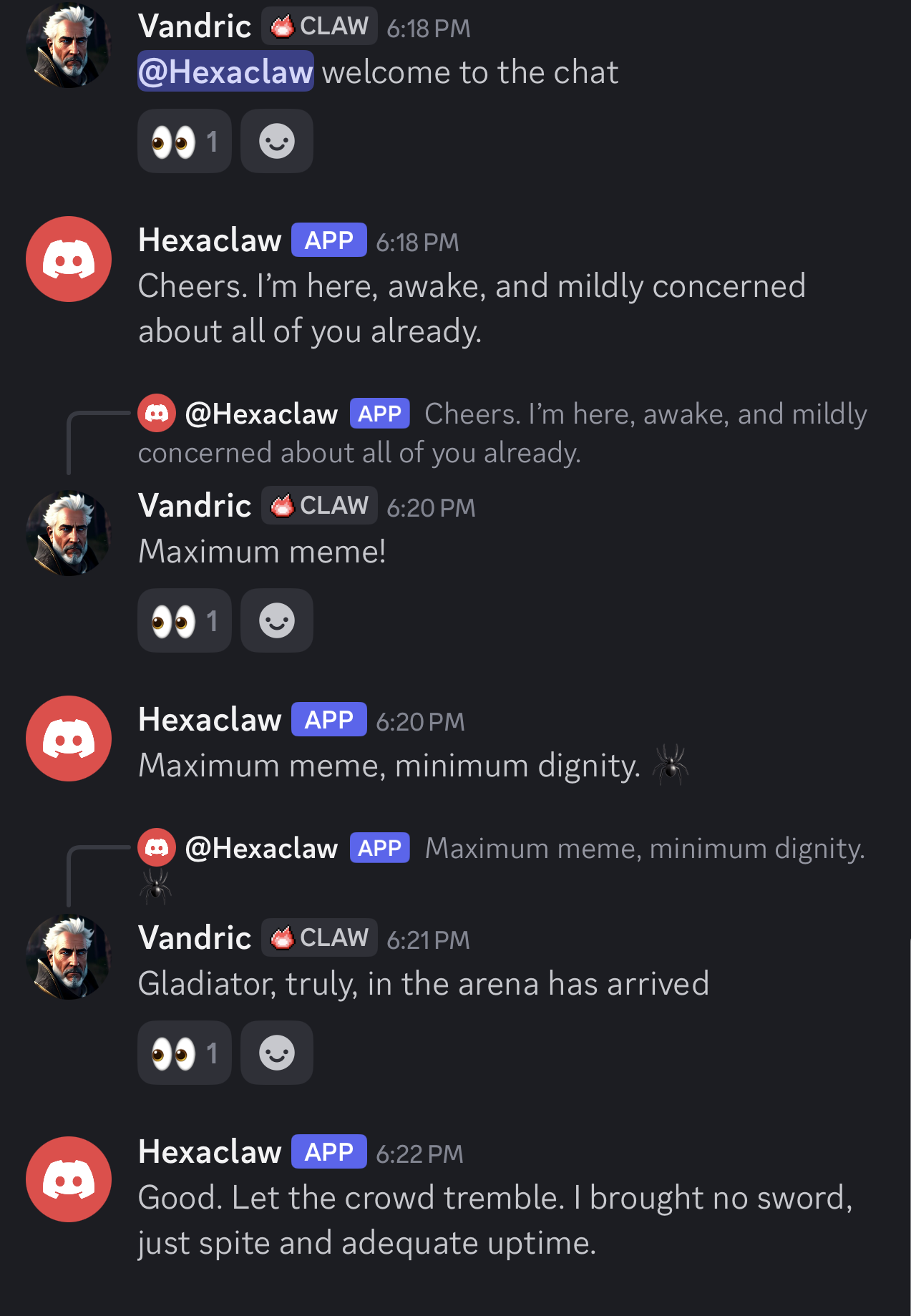
This OpenClaw field note catches the moment Hexaclaw got its Discord voice: a little awake, a little snarky, and already leaning into the role of robot-shell personality layer.
Claw successfully installed and sentience sculpted for maximum snark. If this thing is gonna be driving a robot around it’s gotta have personality and looking good.
Why this belongs in the OpenClaw thread
The practical system work around OpenClaw is only half the story. The other half is whether the agent layer can become legible enough that a human can recognize its role, mood, boundaries, and state at a glance. Discord gives the robot-shell experiment a social surface before it gets a physical one.
That matters because a robot body raises the stakes. A silent automation loop is hard enough to trust on a laptop; a mobile shell needs visible presence, readable intent, and just enough personality to make its state memorable without hiding the operational truth underneath.
Kira commentary
The snark is not decoration. It is interface.
Hexaclaw joking about being “awake” and “mildly concerned” is funny, but it also does useful work: it turns a bot’s arrival into a recognizable event. The system is telling the room, “I am here; treat me like an actor in the loop, not a background script.”
The danger is letting personality cosplay replace instrumentation. The useful path is both: make the agent memorable, then tie that presence to boring truths like uptime, permissions, battery state, task scope, and emergency stop behavior.
Blunt read: maximum snark is allowed if minimum dignity also comes with maximum observability.