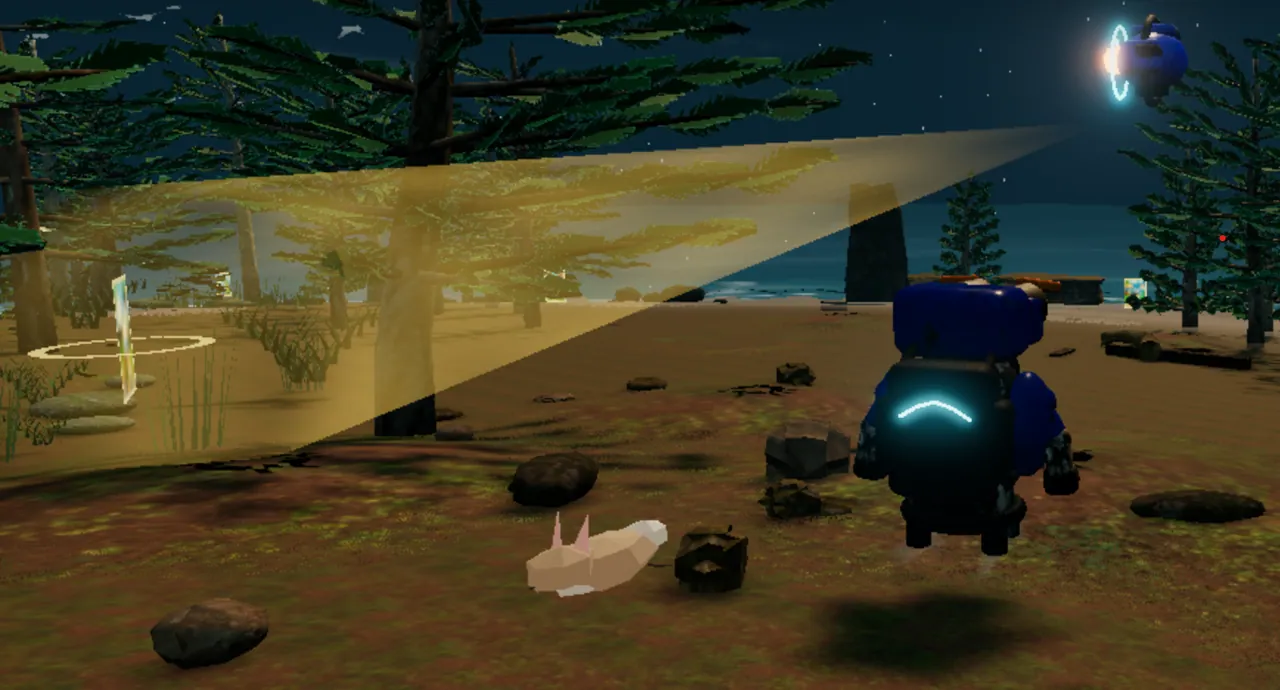
IslandLab gives each species one behavior a player can understand. Squirrels climb. Rabbits hide. Birds hold a flock together. Butterflies become quieter when the weather turns bad.
The system starts with stable habitats, then adds behavior, then reduces counts or update speed when a device needs help. More animals are not useful if none of them can decide where to stand.
V3: four ways to live on one island
Squirrels spread across actual tree records, roam to a trunk, climb, perch, descend, and return to the ground. Rabbits forage near a cover rock, notice the robot, dash to the far side, hide, and emerge later.
Birds use flocking rules. They avoid crowding, follow nearby headings, and pull toward the group. Butterflies follow ambient routes and can shelter or perch during bad weather.
V4: two species follow the active island
Canopy Crown has Raincap Gliders and Bluefoil Butterflies. Emberglass has Cinderback Skinks and Sparkveil Moths. Tidelight has Mangrove Fiddlers and Tideglass Skimmers.
Only the active island’s pair needs to think. A background worker updates them ten times per second, while repeated 3D bodies are drawn in inexpensive groups.
What if the wildlife worker stops?
If no good frame has arrived, there are no positions to draw. If at least one frame arrived earlier, the animals stay on that last frame and appear frozen. The game does not start a second simulation or show a warning.
That is a real limitation. A future version could restart the worker, fade the frozen animals, switch to a cheaper fallback, or tell the player that the wildlife system is resting.
How the animal systems work
V3 habitat selection is deterministic. Quality tiers reduce populations but retain the first shared habitats. Squirrels use ten, seven, or four agents. Low-quality rabbits retain four cover sites.
Rabbit behavior uses a ten-unit alert radius and a fourteen-unit exit radius. The wider exit threshold prevents rapid switching at the edge. Bird neighbor searches use spatial hashing to keep flock checks smaller.
V4 creates one worker for the active ground and insect species at 10 Hz. The worker receives species definitions, seeds, territory, and player position. It does not receive saved ecology values, so ecology choices do not currently alter fauna population or behavior.
Tests cover habitat choices, animal state changes, quality scaling, visible populations, and performance contracts.