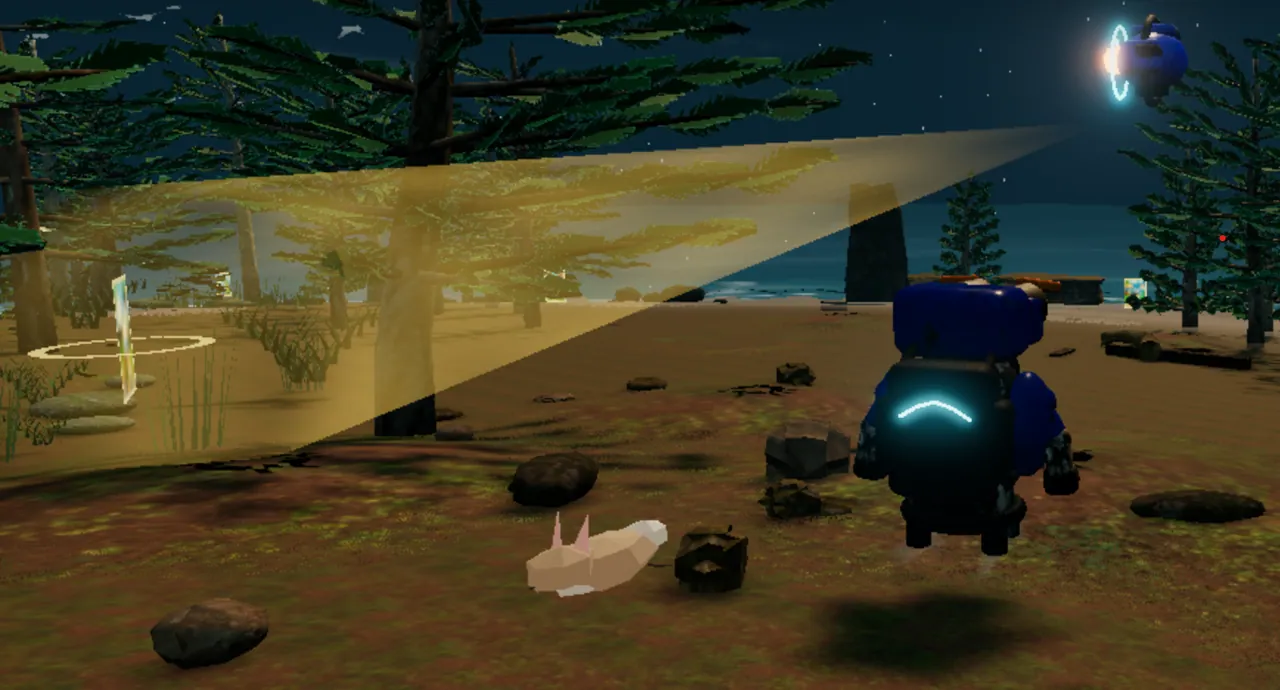
V3 briefly let the player push rocks. Motion was possible, but it never felt convincing. Every weak collision made the island look lighter and cheaper than it had a moment before.
The rocks were already doing several jobs. They shaped views, blocked paths, added terrain detail, and gave rabbits somewhere to hide. Making them movable changed all those jobs at once.
Removing the feature improved the world
The current V3 build keeps rock transforms fixed. Old moved-rock data is ignored during save migration, and tests make sure static rock state does not quietly change.
The rabbit system benefits too. Each rabbit picks a cover rock and finds a hiding point on the far side from the robot. A stable rock gives that small decision a stable piece of geography.
Final ruling: the boulders remain ornate, collidable, useful, and completely uninterested in rolling downhill for entertainment.
What is known about the physics test
The V3 diary records the pushable-rock experiment and says the physics never felt right. It does not preserve a profiler trace or one measured coefficient that would have fixed it.
Mass, friction, slopes, collision shapes, and player force are common factors, but choosing one as the root cause would be a guess. The verified conclusion is narrower: the interaction weakened the build.
A rabbit unit test can move a rock record to confirm that cover calculations read live data. The playable game still follows the fixed-rock rule.