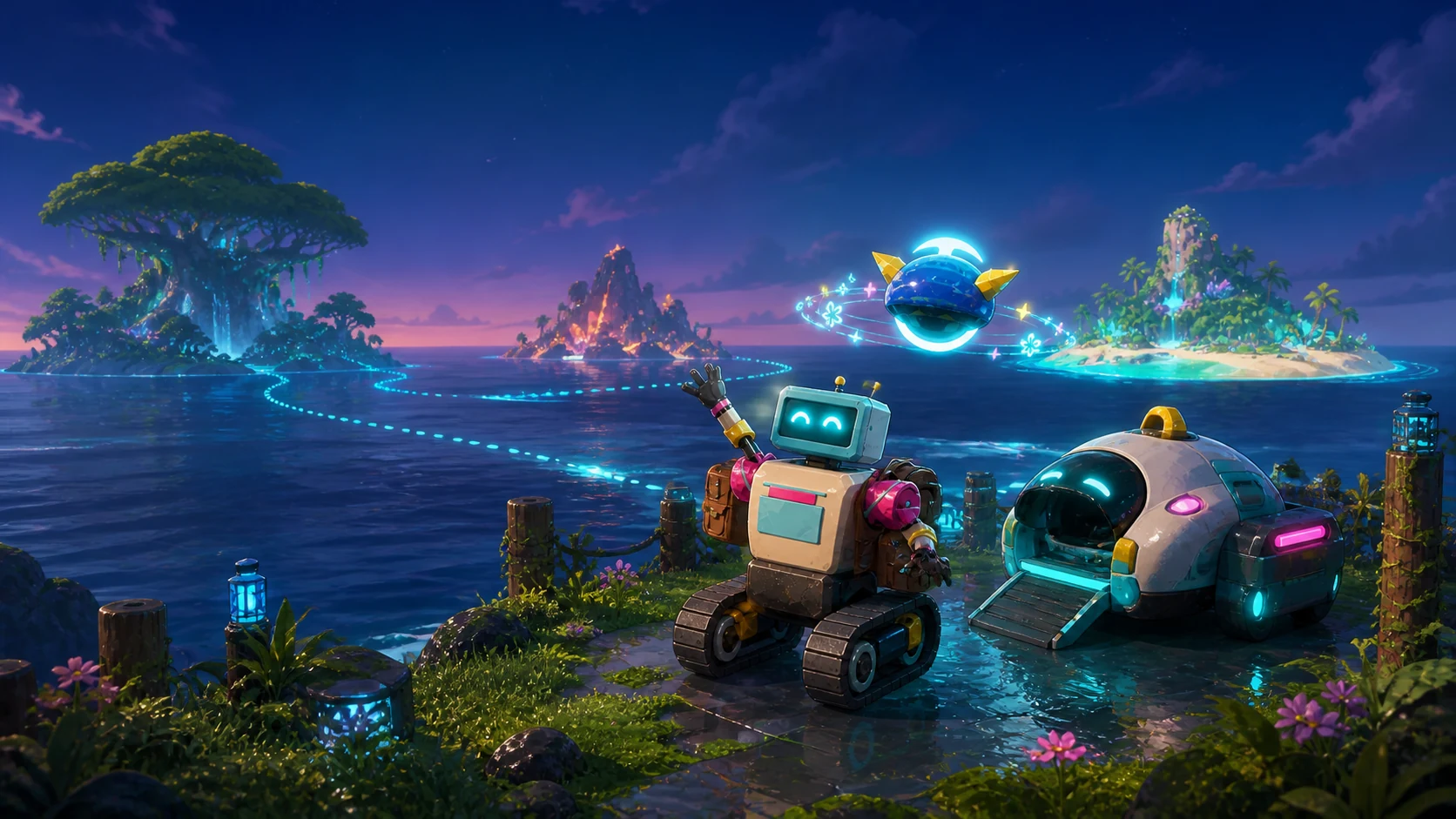
Mote gives the robot someone to look toward. The companion is small, airborne, and bright enough to stay visible against forest, lava, lagoon, and night sky.
It also has work to do. Mote can guide attention toward landmarks, aim a scanner, draw trails, assist a landing, and react when the world changes. The result feels less like following an arrow and more like exploring beside another character.
A companion who notices things
A tall cedar and a patch of light on the ground need different inspection poses. V4 landmarks can tell Mote how high to focus and how far away to hover. On Canopy Crown, five landmarks invite this attention. The dock does not, so arriving infrastructure does not become a grand discovery every time the ship returns.
Mote can idle, worry, puzzle, celebrate, land near the robot, orbit during a drone waltz, and join a signal-listening pose. During the concern animation, it moves closer. A tiny shift in distance does a surprising amount of emotional work.
Was Mote in V3?
V3 has a helper drone. Its Field League roster also includes a trainer called Unit Mote. V4 names this companion Mote. No source says all three are the same machine.
The safe, simple version is this: Mote is the V4 companion. The V3 helper drone is a design precursor. Unit Mote remains a separate League name.
How Mote works
Landmark records can enable companion interest and provide a focus height and stand-off distance. Scanner effects, trails, the drone shell, and its optic share a target solution so they point to the same place.
The repository also contains three locally generated candidate arrival lines, one per island, with recorded model provenance. The current game does not load that voice file, so the lines are not live dialogue.
Robot and companion choreography is built from both sides. Mote has its own emotional states, while the robot has poses made to include Mote.