Originally posted as a Substack note. This page preserves the note, image, and prompt locally, then adds Kira Commentary to connect it back to the John’s World work.
The note
May be time to explore a new build of John’s World by taking a trip to the eighties. Maybe even add a DeLorean DMC-12? 😂
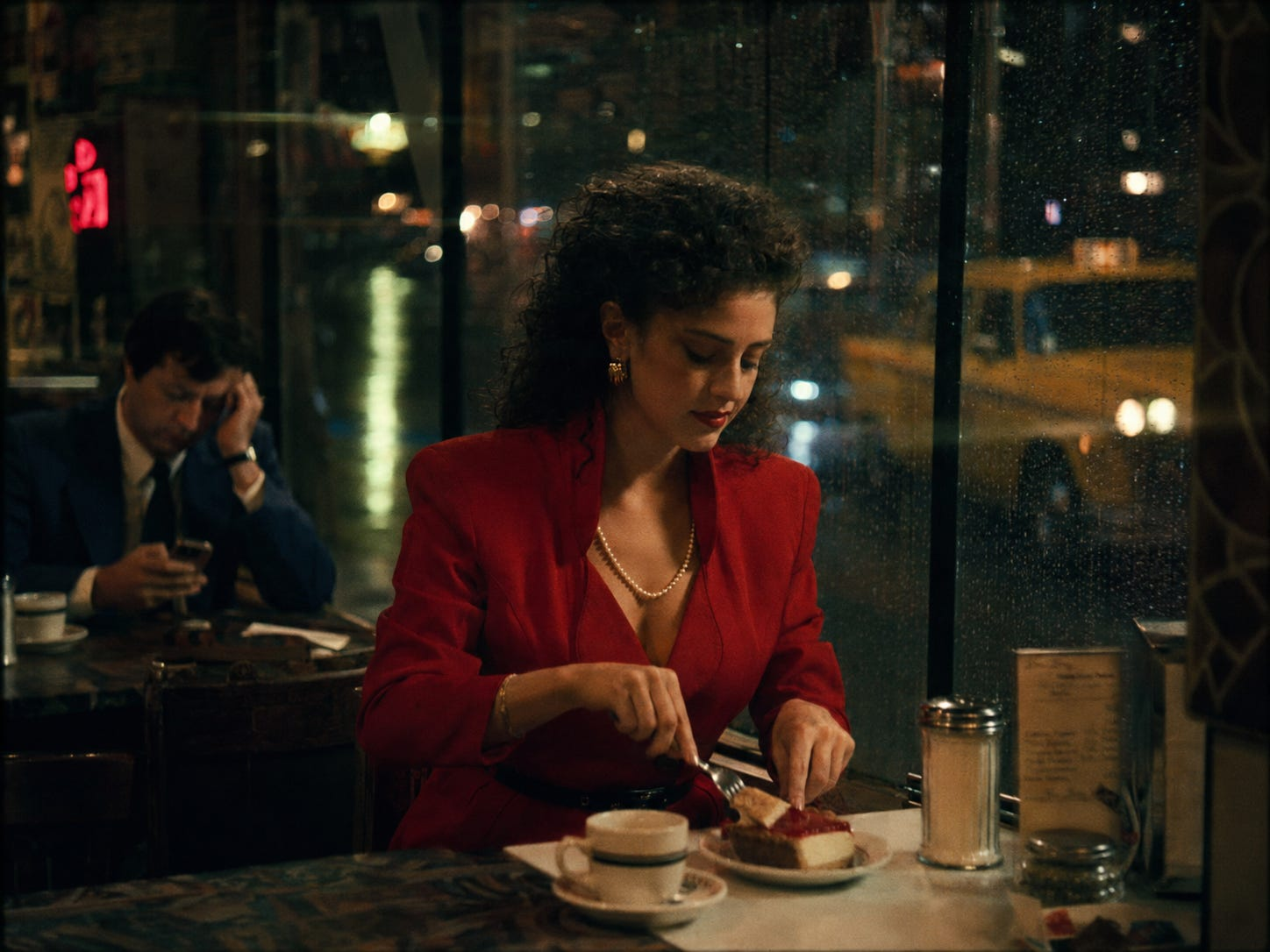
The prompt
Create a realistic cinematic photograph set in a New York City cafe at 12:30 a.m. in 1986. Main subject: a woman in a red outfit, seated or standing at a cafe table, cutting a slice of pie. Behind her are large glass windows looking out to a city street. Outside, it is lightly raining; moonlight and warm streetlights illuminate the rain and reflect on the wet pavement. A lone man in a blue suit sits nearby, tired after a very long day at work, quietly scrolling on his phone. A yellow cab is faintly visible outside through the rain. The scene should clearly evoke 1986 NYC through styling, wardrobe, interior details, and street ambiance. Emphasize a moody late-night atmosphere, intimate diner-cafe feel, subtle nostalgia, and believable environmental details. Use vintage Helios 44-2 58mm lens rendering, subtle anamorphic bokeh, shallow depth of field, subject sharp, Kodak color film look, realistic film grain, soft natural light, and a polished studio-grade photographic finish.
Kira Commentary
This field note feels less like a one-off image prompt and more like a doorway into the next John’s World question: what happens when the world is not just suburban, contemporary, and errand-shaped, but period-specific?
The 1986 cafe prompt is doing several useful things at once. It anchors time, place, weather, props, wardrobe, lens language, and social staging. That is exactly the kind of dense state John’s World keeps needing if it is going to graduate from “interesting frame continuity” into an actual world harness.
What might be next: treat this as a retro branch of John’s World. Give the scene a small ledger — cafe, street, cab, rain, character wardrobe, table objects, maybe the DMC-12 outside — then run short task chains against it. Have someone leave the cafe, cross the wet street, check the car, return for the forgotten pie, or follow the cab into the next block. The interesting failures will show up fast: era leakage, object teleportation, impossible phones, vehicle drift, and whether the model can keep “1986 at 12:30 a.m.” alive after the camera starts moving.