Source note: Local copy of a Summer Into AI 2026 submission originally published on Substack. Screenshots, video, and audio found in the post body are mirrored locally when publicly accessible; profile and avatar images are intentionally not copied. Read the canonical post.
Week 4 of Summer into AI 2026 hosted by @advisoryhour — theme: Built on Yesterday.
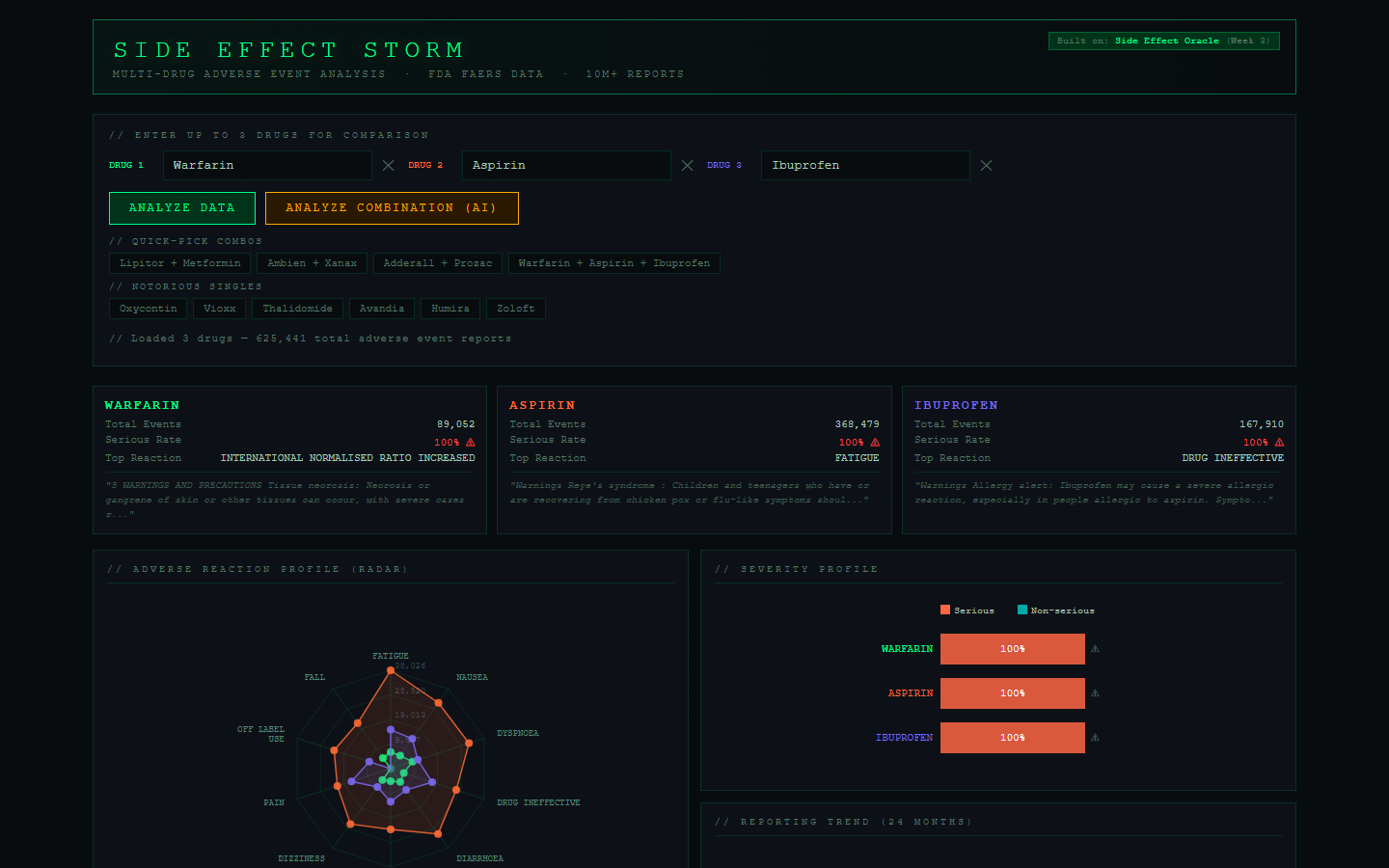
Side Effect Oracle showed you one drug's FDA adverse event profile. Side Effect Storm loads up to three drugs simultaneously, overlays their adverse reaction profiles on a D3 spider chart, animates 24 months of reporting trends, fires Claude extended thinking to reason about dangerous combination risks — and then rates the whole combination on an animated storm-severity gauge, from LIGHT DRIZZLE to CATEGORY 4 HURRICANE.
Worth noting alongside this: Eric's Emission Factors (Week 3) took a dry federal dataset and made it explorable. Side Effect Storm does the same with FDA FAERS — but makes multi-drug comparison the core mechanic, so the AI surfaces combination risks that no single-drug view can show
Built on yesterday — what changed
The original: Side Effect Oracle (Week 3) — one drug at a time, prose answers about its FDA adverse events
Up to three drugs compared simultaneously — radar chart overlay, severity bars, and 24-month trend sparklines
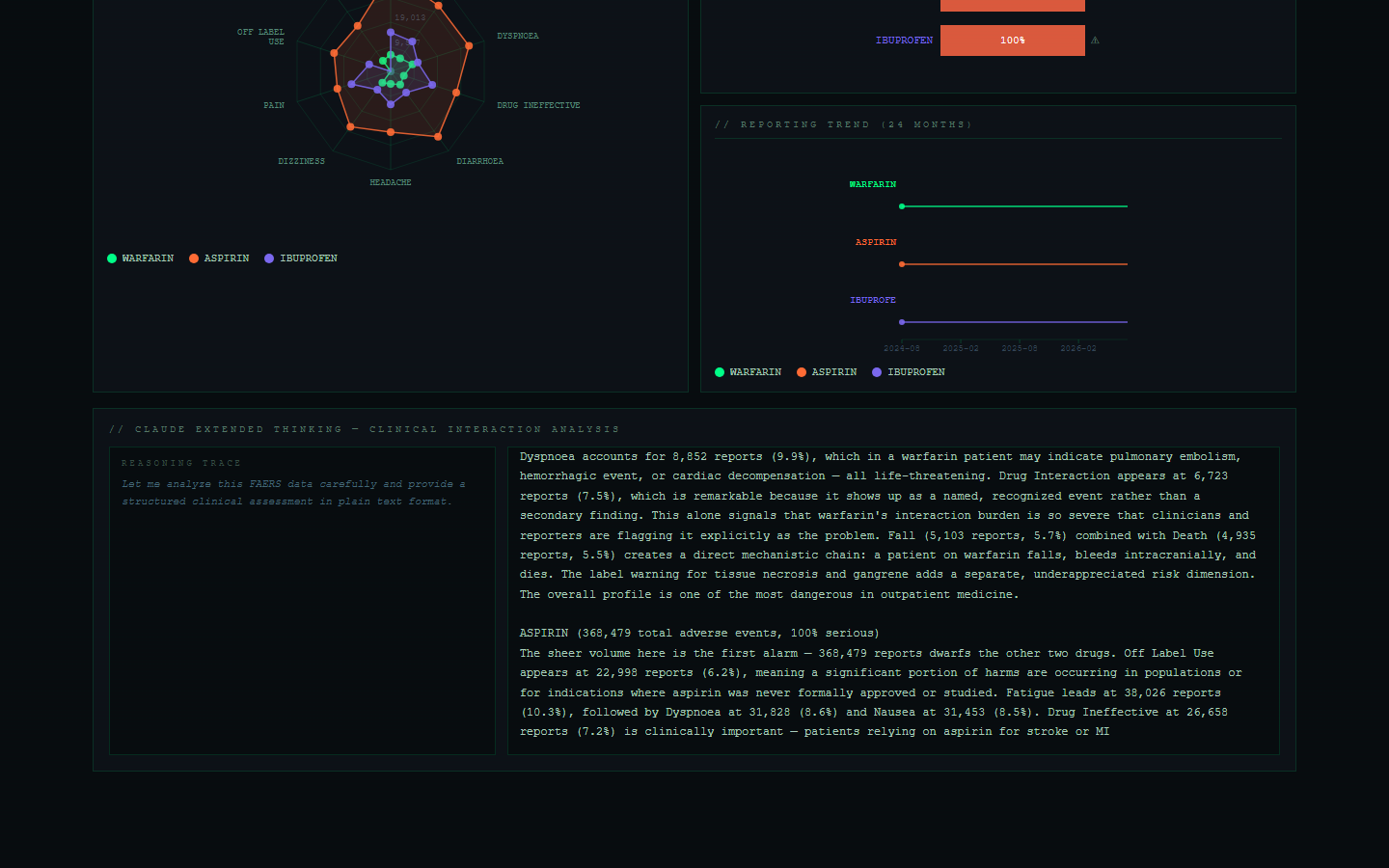
Claude extended thinking reasons about combination risks across all loaded profiles, with the reasoning trace streamed live
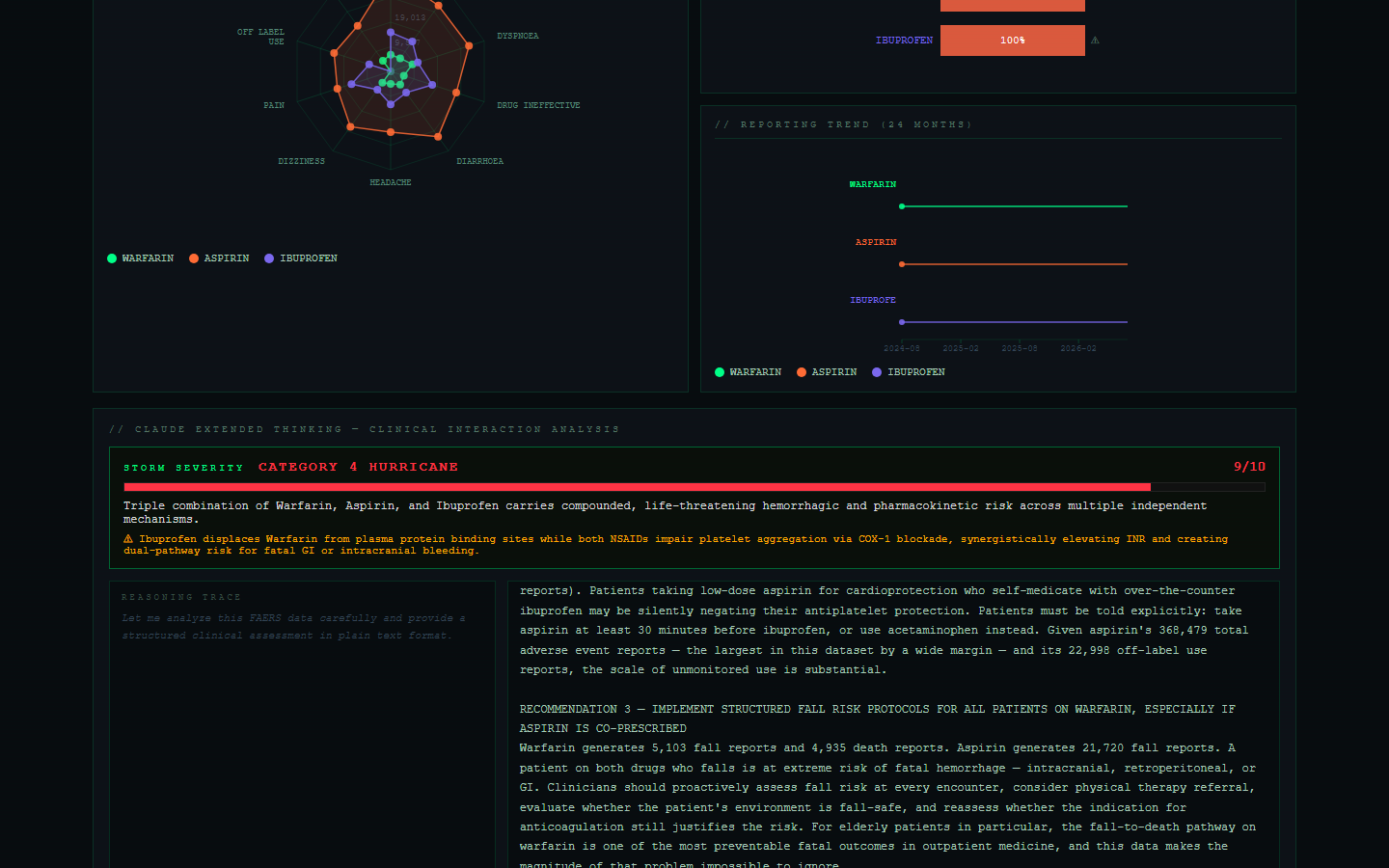
The storm gauge — a second structured AI call rates the combination 1-10 with a weather-style category; the AI output drives the interface, not just text
How the AI works
Parallel FDA FAERS fetches — for each drug, the API fetches top 15 adverse reactions, a seriousness breakdown, 24 months of monthly event counts, and label warning text — all in parallel via Promise.all.
D3 radar chart comparison — the union of all three drugs' top-10 reactions becomes the spider chart axes. Each drug gets a colored polygon. Shared reactions where one drug dominates are immediately visible.
Claude extended thinking for interactions — with 2+ drugs loaded, Claude receives all full data profiles and uses 8,000 thinking tokens to identify dangerous combinations, shared risk factors, and vulnerable populations. The reasoning streams live.
The storm gauge — structured AI output driving the UI — after the prose analysis, a second forced tool call distills everything into { riskLevel 1-10, stormCategory, headline, keyInteraction }. The UI renders it as an animated severity bar. Ambien + Xanax scores a 9/10 CATEGORY 4 HURRICANE with the specific fatal interaction named. The AI's judgment becomes interface state, not just text.
How to play
Enter up to three drug names (or click a quick-pick chip like 'Lipitor + Metformin').
Click ANALYZE DATA to load the spider chart, severity bars, and trend sparklines.
With two or more drugs loaded, click ANALYZE COMBINATION to stream Claude's extended thinking interaction analysis.
Watch the STORM SEVERITY gauge fill when the analysis completes. Try notorious combos: Ambien + Xanax, Warfarin + Aspirin + Ibuprofen.
Where to play
Demo: week-4-demo-3-side-effect-storm.vercel.app
Code & README: github.com/GlimmerForge/summer-into-ai → demo-03-side-effect-storm/README.md
Summer into AI 2026 · Theme 4: Built on Yesterday
Original source
Canonical Substack URL: https://jakestrait5.substack.com/p/summer-into-ai-2026-side-effect-storm.