Source note: Local copy of a Summer Into AI 2026 submission originally published on Substack. Screenshots, video, and audio found in the post body are mirrored locally when publicly accessible; profile and avatar images are intentionally not copied. Read the canonical post.
Week 4 of Summer into AI 2026 hosted by @advisoryhour — theme: Built on Yesterday.
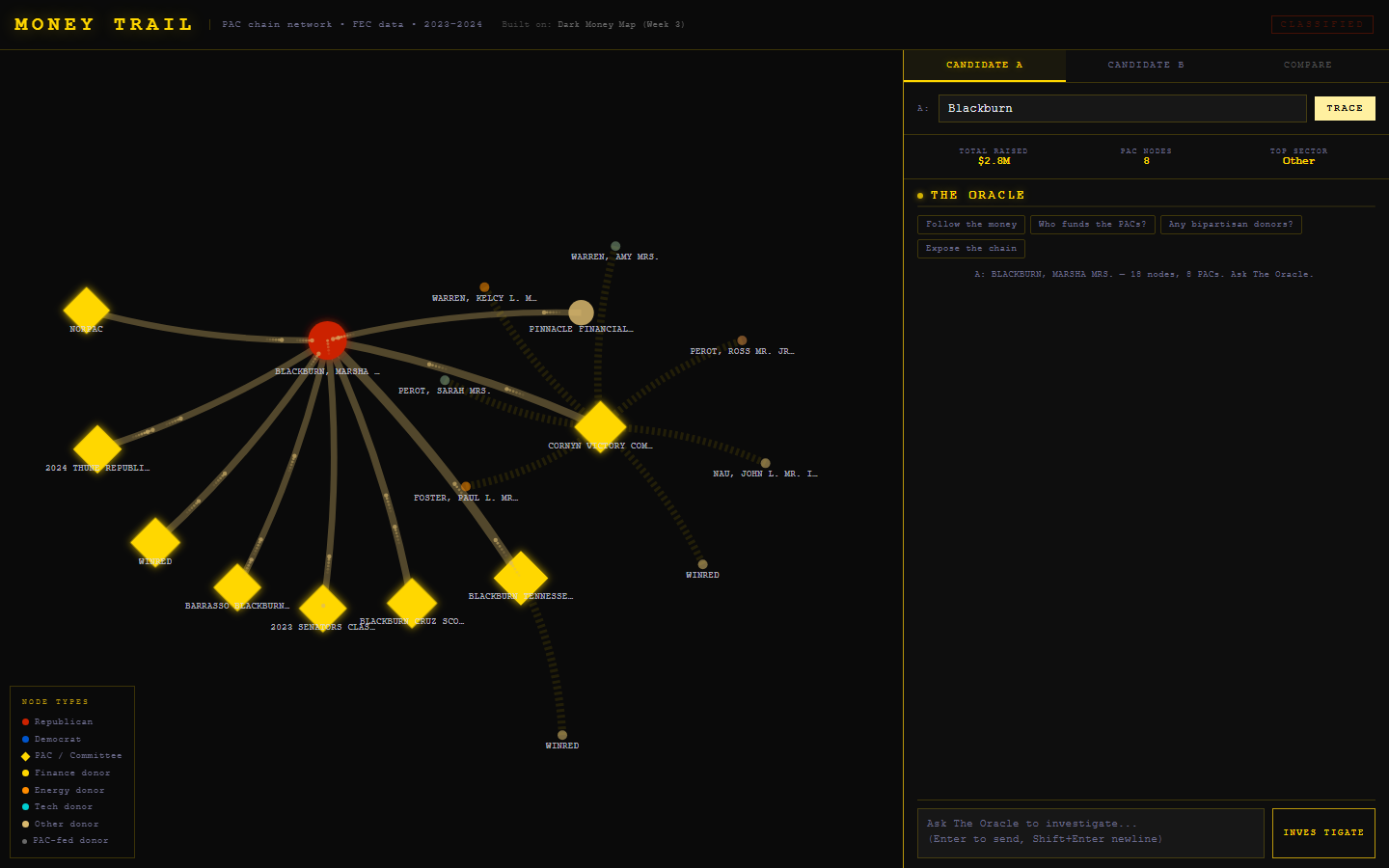
Dark Money Map showed you which PACs donated to a candidate. Money Trail goes three layers deeper — it traces PAC donors to discover who funds the funders, renders the whole network as a live D3 force graph, and then runs Claude extended thinking to surface the hidden patterns a human analyst would spend days finding.
Worth noting alongside this: Eric's NASA Patents Decoder (Week 3) took a federal open-data API (NASA patents) and used AI to decode what the jargon actually means. Money Trail applies the same instinct to FEC campaign finance data — but adds graph traversal, so the AI isn't explaining single records, it's reasoning over a three-layer network of them
Built on yesterday — what changed
The original: Dark Money Map (Week 3) — a single-layer FEC donor visualizer with a basic chat oracle
Three-layer money tracing — the original showed direct donors only; Money Trail follows PAC contributors to discover who funds the funders
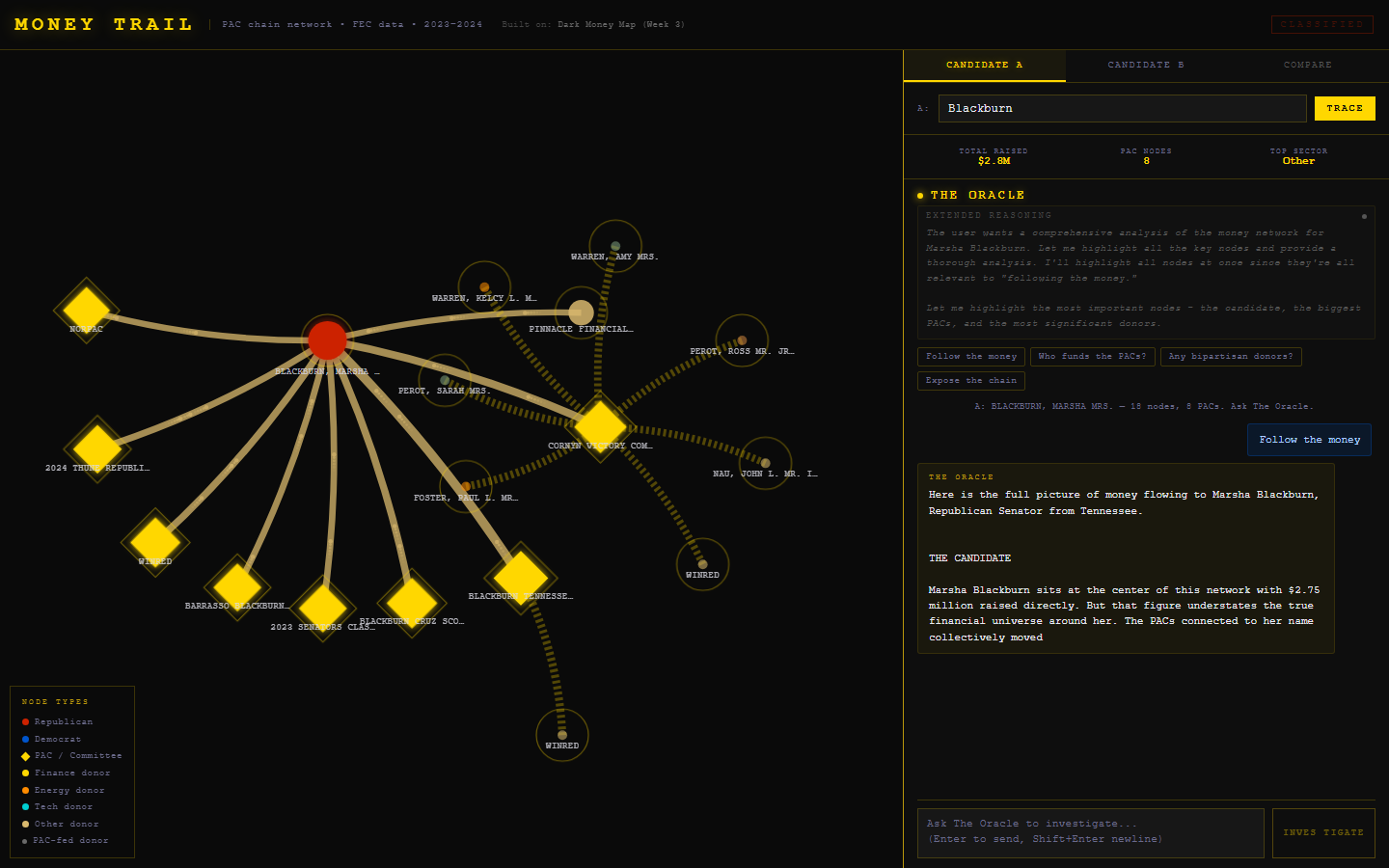
The Oracle now uses Claude extended thinking (10,000 reasoning tokens streamed live) and highlights the nodes it names directly on the graph via tool calls
Compare mode — load two candidates side by side and spot shared donors glowing with white rings
Real fundraising totals from the FEC totals endpoint, and node sizes scaled by dollar amount
How the AI works
Three-layer PAC traversal — the FEC API returns each contributor's ID. Any ID starting with 'C' is itself a committee; the demo auto-fetches that committee's donors too, building a donor → PAC → candidate graph in one pass. Real fundraising totals come from the FEC candidate totals endpoint.
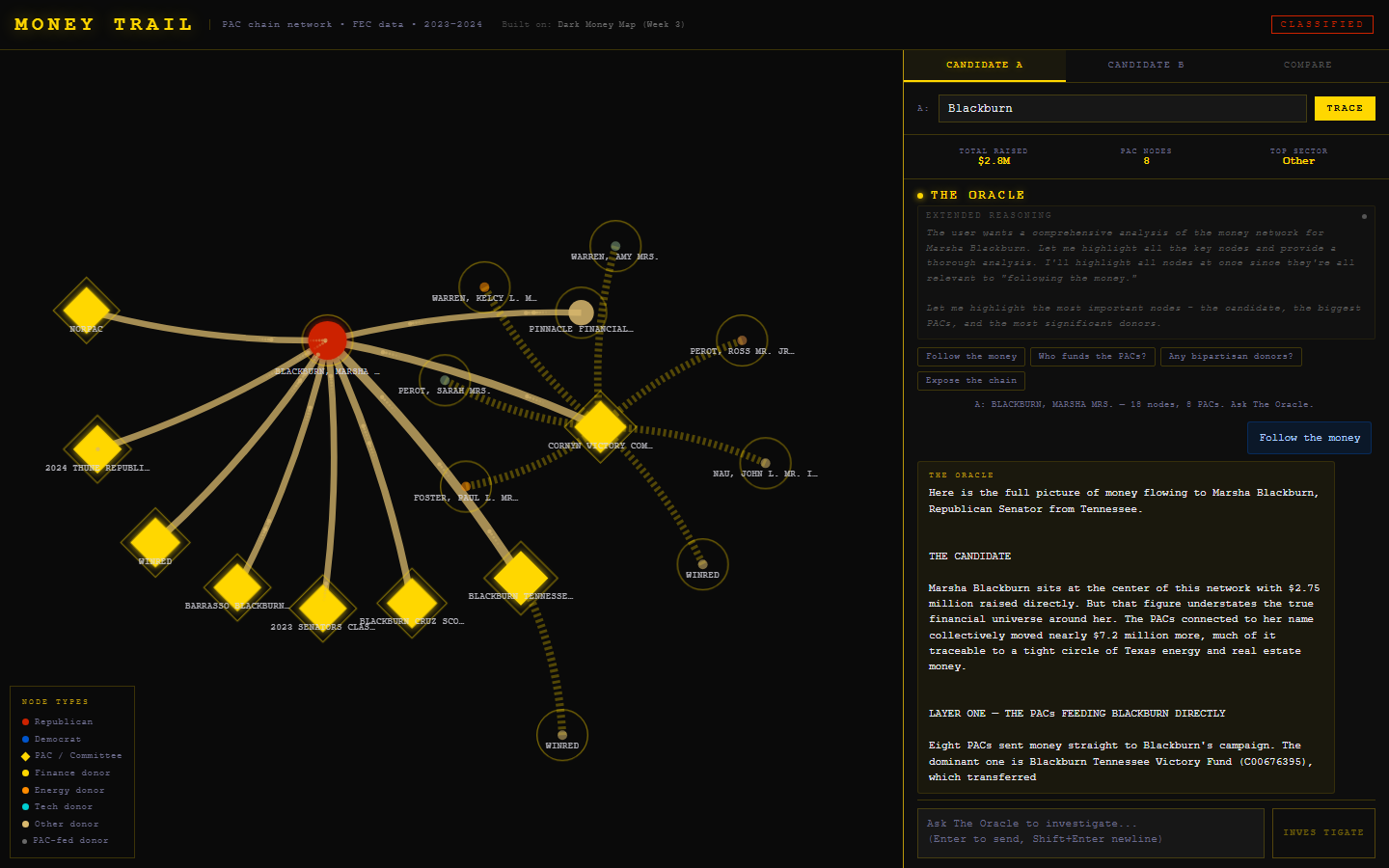
Claude extended thinking as oracle — after the graph loads, Claude reasons step-by-step through the full network data using 10,000 thinking tokens, then uses a highlight_nodes tool to surface the most suspicious clusters. You watch the reasoning happen in real time, and the graph lights up as it names names.
Compare mode — load two politicians side by side and ask Claude to identify shared donors, cross-network PAC patterns, and who is really pulling both strings.
How to play
Enter any politician's name and click TRACE.
Watch the force graph populate — gold diamonds are PACs, circles are individual donors, dashed edges mean 'funds through an intermediary.'
Click ASK THE ORACLE to stream Claude's extended thinking analysis. The reasoning panel expands automatically.
Try compare mode: enter two candidates and see which donors appear in both networks.
Where to play
Demo: week-4-demo-1-money-trail.vercel.app
Code & README: github.com/GlimmerForge/summer-into-ai → demo-01-money-trail/README.md
Summer into AI 2026 · Theme 4: Built on Yesterday
Original source
Canonical Substack URL: https://jakestrait5.substack.com/p/summer-into-ai-2026-money-trail.