Source note: Local copy of a Summer Into AI 2026 submission originally published on Substack. Screenshots, video, and audio found in the post body are mirrored locally when publicly accessible; profile and avatar images are intentionally not copied. Read the canonical post.
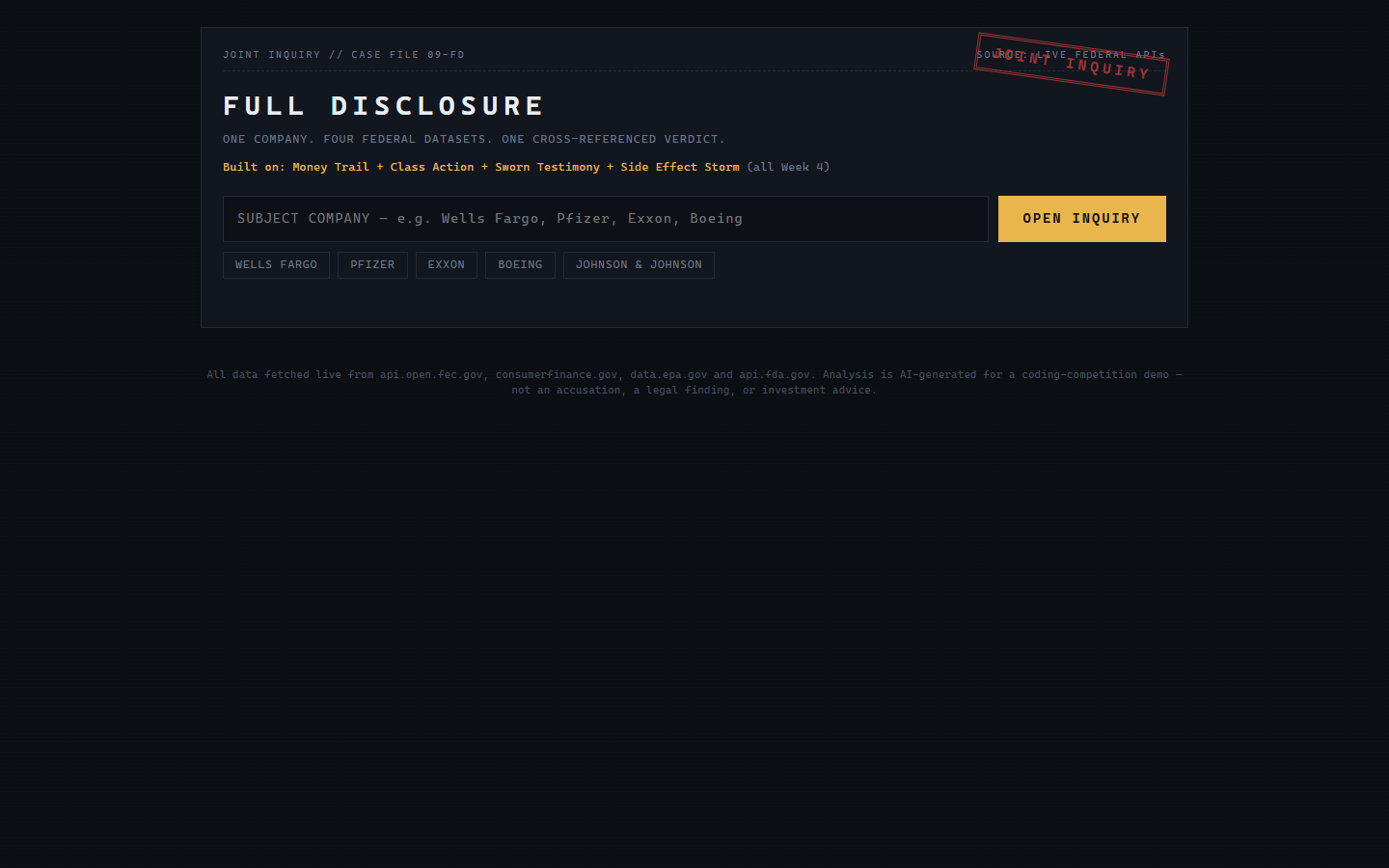
Week 4 of Summer into AI 2026 hosted by @advisoryhour — theme: Built on Yesterday.
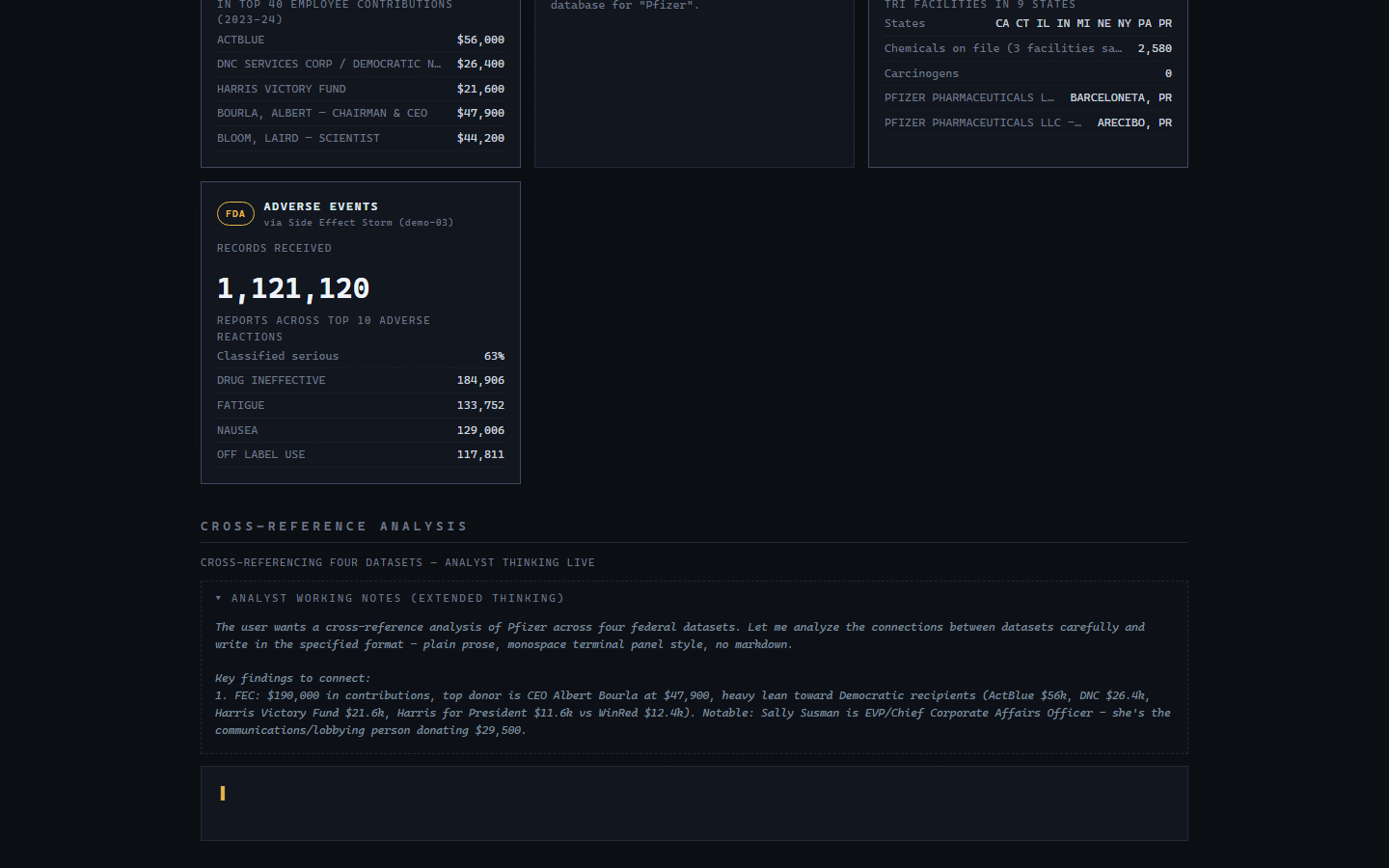
The finale, and the theme taken literally: a demo built on four of this week's demos at once. Name a company. Four federal datasets open on it in parallel — FEC political money, CFPB consumer complaints, EPA toxic releases, FDA adverse events — using the exact data pipelines from Money Trail, Class Action, Sworn Testimony, and Side Effect Storm. Then Claude cross-references what no single-dataset tool can see, and a review board issues a Disclosure Index from 0 (clean) to 100 (alarming).
Worth noting alongside this: Eric's Arcadia (Week 4) gathered the whole competition's history into one 3D arcade — breadth as tribute. Full Disclosure gathers four data integrations into one investigation — breadth as leverage: the datasets interrogate each other
Built on yesterday — what changed
The original: Money Trail + Class Action + Sworn Testimony + Side Effect Storm (all Week 4) — four demos, four federal datasets, each previously investigating alone
One inquiry, four bureaus: the FEC fetcher from Money Trail, the CFPB discovery from Class Action (including its fuzzy company resolution), the EPA TRI pipeline from Sworn Testimony, and the FDA FAERS profile from Side Effect Storm — running in parallel on the same defendant
Cross-dataset reasoning: Claude's synthesis is required to connect datasets, not summarize them — political donations against complaint volume, donation recipients against oversight agencies, environmental footprint against consumer harm
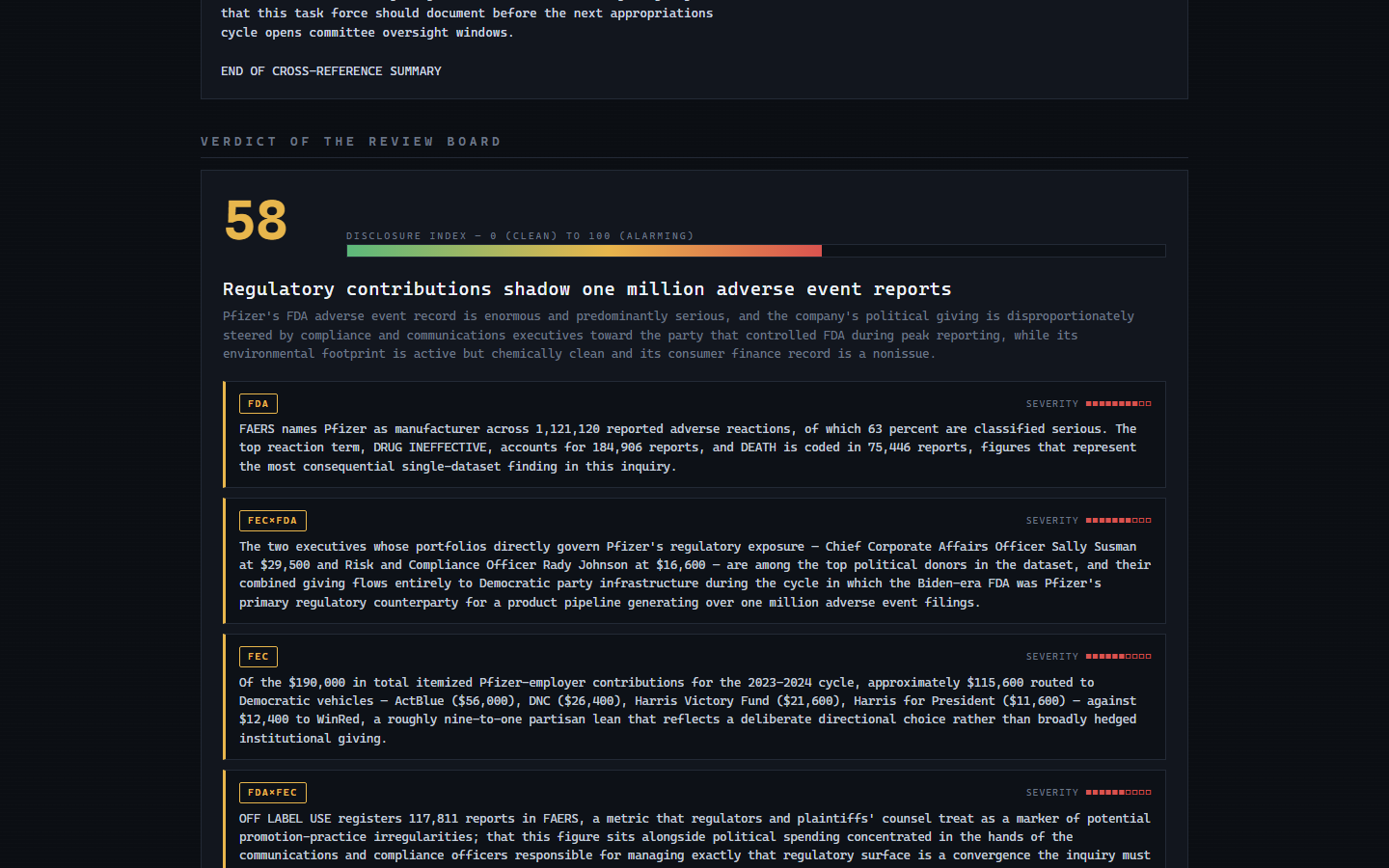
A structured verdict: the Disclosure Index meter plus finding cards badged by which datasets they connect (FEC×CFPB, FDA×FEC...), each with a severity rating
Real run: Pfizer scored 58 — the board flagged two named compliance executives whose political giving flows to the party controlling the FDA during a period of one million adverse event filings
How the AI works
Parallel bureau reports — four live federal fetches land independently, each panel filling in as its agency responds. Missing exposure degrades gracefully: a bank shows RECORD SILENT at the FDA; a pharma giant lights it up.
The cross-reference — all four raw datasets go to Claude with extended thinking (streamed to a collapsible analyst panel). The prompt demands connections across datasets — the finding that makes this demo is never visible in any one database.
The review board — a final structured verdict: Disclosure Index 0-100 on an animated meter, a headline, and 3-5 findings each badged with the datasets it links and a severity bar.
How to play
Name a defendant: Wells Fargo, Pfizer, Exxon, Boeing — any company with a federal footprint.
Watch the four bureau panels land in parallel and read each agency's headline numbers.
Follow the streamed cross-reference, then read the Verdict of the Review Board — the Disclosure Index and the dataset-pair findings are the payoff.
Compare defendants: a bank, a drugmaker, and an oil major produce completely different four-bureau silhouettes.
Where to play
Demo: week-4-demo-9-full-disclosure.vercel.app
Code & README: github.com/GlimmerForge/summer-into-ai → demo-09-full-disclosure/README.md
Summer into AI 2026 · Theme 4: Built on Yesterday
Original source
Canonical Substack URL: https://jakestrait5.substack.com/p/summer-into-ai-2026-full-disclosure.