Source note: Local copy of a Summer Into AI 2026 submission originally published on Substack. Screenshots, video, and audio found in the post body are mirrored locally when publicly accessible; profile and avatar images are intentionally not copied. Read the canonical post.
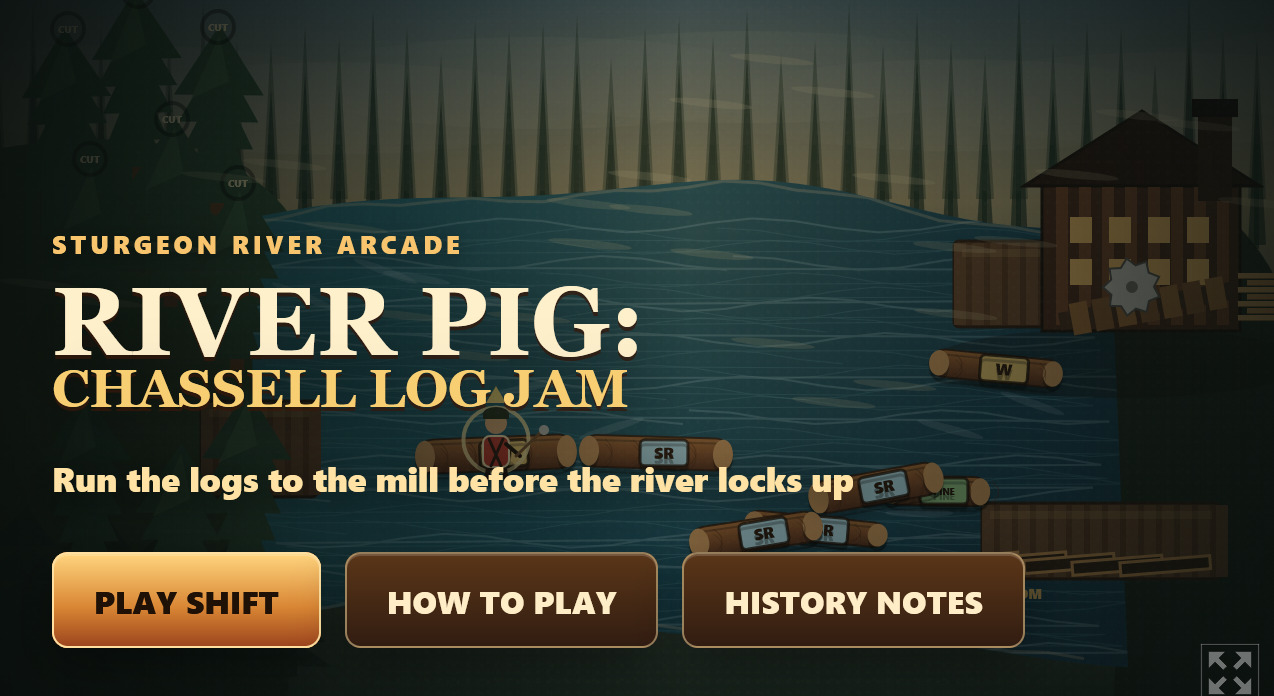
Play it here:
https://kdgodfrey.itch.io/river-pig-chassell-log-jam
For Week 2 of Summer Into AI 2026, the theme was Independence Engines.
I started thinking about independence as something practical — not just a symbol, but a system that keeps working because people keep it moving.
Somehow that turned into a Chassell logging game.
The game is called River Pig: Chassell Log Jam. You chop trees, send logs into the river, jump across floating timber, break up log jams, dodge beavers and chickens, and try to keep the sawmill fed before the shift ends.
It is local history turned into arcade chaos.
Logging as an engine
Chassell’s old sawmill history felt perfect for this theme because logging really was an engine for progress.
Timber was not just timber. It fed everything around it. Lumber supported mining, railroads, docks, shipping, buildings, and the growth of the Copper Country. Before any of that could move forward, the trees had to come down, the logs had to reach the river, the river had to carry them, and the mill had to keep running.
That became the core idea of the game:
The mill only works if the river keeps moving.
And the river only works if someone is willing to deal with the jams.
The game loop
In River Pig: Chassell Log Jam, you play as a log driver — also known as a river pig — trying to keep the whole operation alive.
The loop is simple:
Chop trees
Get logs into the river
Jump from log to log
Break up jams with a peavey
Feed the sawmill
Try not to fall into the Sturgeon River
When the logs reach the mill, the system works. The sawmill comes alive, the score goes up, and progress keeps moving.
When the logs jam, everything backs up.
That is where the theme really clicked for me.
Independence is a flow problem
The more I built the game, the more I liked the idea that independence is not always a dramatic speech or a flag waving in the wind.
Sometimes independence is a jammed-up system that needs to be cleared.
A log jam is a problem you can see. One stuck point blocks everything behind it. The logs pile up. The river stops doing its job. The mill gets hungry. Everyone downstream is annoyed. Somewhere, a beaver is absolutely making it worse.
That is basically project management, but wetter.
The player’s job is to restore flow:
Break the jam. Feed the mill. Keep the engine running.
One official log in the jam
Since I only get one official competitor reference, I am making it count.
My official reference is Myles Dependency Day, because it gave me the cleanest way to explain my own game:
A log jam is just a dependency blocker with bark.
In Dependency Day, the idea of blocked systems and dependencies helped me think about independence less as a single heroic moment and more as a chain of things that need to move together.
In River Pig, I made that idea physical.
Instead of looking at a blocked system on a screen, the player has to jump onto the system, run across it, hit it with a peavey, and hope the whole thing starts moving before they fall in the river.
So if Dependency Day is the strategy meeting where everyone identifies the blocker, River Pig is the part where someone in suspenders yells, “I’ll handle it!” and leaps onto a floating pine log with absolutely no risk assessment.
What AI helped with
AI helped me move from a rough idea to a playable browser game much faster than I could have on my own.
The process was:
Start with the Chassell sawmill idea.
Turn it into a game loop.
Use AI to write a Codex-ready prompt.
Build the first version.
Play it.
Notice what was fun and what was frustrating.
Prompt improvements.
Test again.
The first version was fun, but it was too hard too fast. The logs moved quickly, there were not enough safe ones to ride, and I could not get used to the jumping before the chaos started.
That became the real design lesson.
AI can help build the thing, but I still had to play it and say:
This is fun, but the river is bullying me.
So the next pass focused on slower beginner logs, more rideable platforms, more forgiving jumps, and a better opening ramp.
The river should welcome you in first.
Then it can try to drown you with beavers.
Final note
River Pig: Chassell Log Jam started as a local history idea and turned into one of my favorite builds so far.
Chassell gave me the setting. Logging gave me the engine. The river gave me the movement. The log jams gave me the mechanic.
And the beavers gave me problems.
Which is exactly what a game needs.
Play it here:
https://kdgodfrey.itch.io/river-pig-chassell-log-jam
Original source
Canonical Substack URL: https://kadygodfrey.substack.com/p/river-pig-chassell-log-jam-my-week.