Source note: Local copy of a Summer Into AI 2026 submission originally published on Substack. Screenshots, video, and audio found in the post body are mirrored locally when publicly accessible; profile and avatar images are intentionally not copied. Read the canonical post.
I Built an App to Track an AI Competition
This is my Week 2 (Red, White, Boom!) submission for the Summer Into AI Competition, which is a public AI build competition where people make projects, publish them, show proof, and earn points.
That sounds simple.
Then people started submitting things.
A lot of things.
Some people had one project. Some people had several. Some projects had a Substack post and a live demo. Some had a Substack post, a live demo, and GitHub. Some people wrote about other people’s projects. Some projects had names that sounded similar enough that I had to stare at them for a while and wonder whether I was looking at one thing or three things wearing a trench coat.
At some point I realized I did not just want to know the leaderboard.
I wanted to know what was happening underneath the leaderboard.
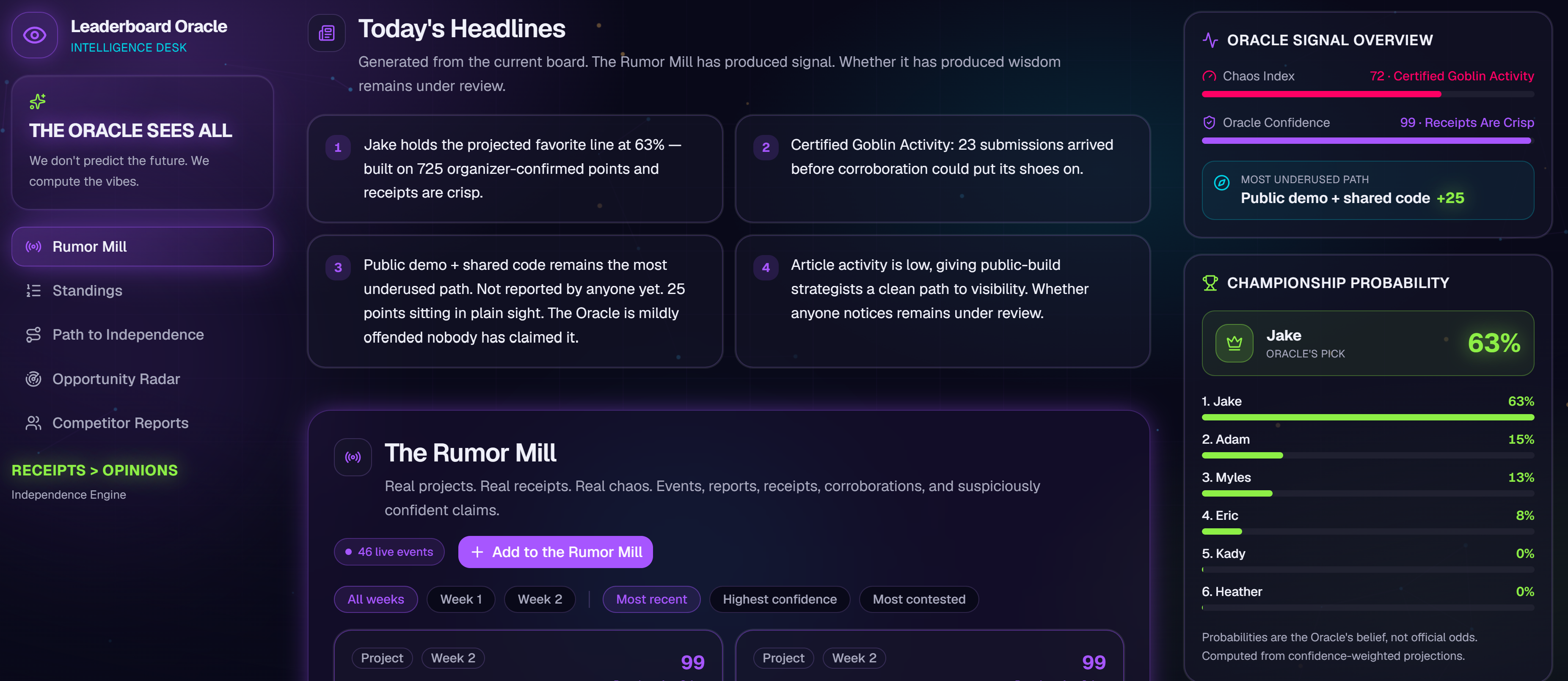
So I built Leaderboard Oracle.
It’s basically a competition tracker for Summer Into AI. It keeps track of competitors, projects, scored events, point totals, and the pieces of evidence that explain why someone has the score they have.
This is not a production app. It is not trying to be beautiful software for the ages. It is a practical app for a specific competition, built because I wanted a clearer answer to one very important question:
How worried should I be?
The competition is simple, but the data gets messy fast
The rules are clear enough. You build something, publish it, and show proof. Different kinds of posts and proof are worth different point values.
But once multiple people start building multiple things, the scoring gets hard to follow casually.
A project is not always the same thing as a scored event.
That was the big thing I had to sort out.
A project is the thing someone made.
An event is the thing that earns points.
So if someone builds a project and posts a Substack article with a live demo, that’s a scored event. If they also share code, that changes the point value. If they write a separate post about someone else’s project, that may be another scored event.
The app needed to understand that difference.
Otherwise it would be very easy to accidentally treat a project like it earned points just by existing, which, unfortunately, is not how life works.
Week 2: Red, White, Boom!
The theme led to a lot of projects with Revolutionary War names, fireworks names, liberty names, founding father names, and at least one project title that made me question whether everyone else was sleeping.
This app just watches events and scores, with some fireworks in the background. Every competition eventually needs one person in the corner with a spreadsheet asking, “Wait, does that count?”
Apparently that person is me.
My favorite feature: Path to Independence
My favorite part of the app is called Path to Independence.
The name sounds dramatic, but the feature is very practical.
It looks at where a competitor is in the standings and shows what it would take for them to move up.
For example, if someone is 35 points behind the next person, the app can show whether one strong submission would close the gap. It can show whether a smaller submission would help but not be enough. It can make the difference between “I’m behind” and “I need one Substack post with a demo and code.”
That is the kind of information I wanted.
Not motivation. Not vague encouragement. Just the actual math.
Because when you’re looking at a leaderboard, “you can do it” is less helpful than “you need 40 points.”
Path to Independence makes the competition feel more playable. It turns the leaderboard from a static ranking into a strategy view.
It answers the question I actually have:
What would it take?
My other favorite feature: Opportunity Radar
The other part I really like is Opportunity Radar.
This feature looks for places where there may be points available or useful moves to make.
That might mean noticing that someone has a project but not much proof attached. Or that a competitor could gain ground with one complete submission. Or that there are scoring opportunities people may be missing because they are focused only on building and not on publishing, explaining, or documenting.
This matters because in this competition, the work does not really count unless it is visible.
You can build something cool, but if there is no post, no demo, no code, or no clear explanation, it may not help your score very much.
Opportunity Radar is basically the part of the app that says:
You might be leaving points on the table.
Which is annoying.
But useful.
The rumor mill is part of the data model
One of the funniest parts of building this app was realizing that the leaderboard is not just made of official scores.
It is also made of the rumor mill.
Someone mentions that a project exists. Someone says they saw a demo. Someone else knows there was a Substack post. A GitHub link appears in the wild. A project title shows up twice with slightly different punctuation and suddenly I am trying to decide whether these are duplicates or if someone really did make two separate liberty-themed apps with almost the same name.
This is where the app gets practical.
Not every piece of information should immediately become points. That would be a mess. But it is still useful to track what people are hearing, what might exist, and what needs confirmation.
So the app separates confirmed events from softer signals.
A confirmed event is something I’m comfortable treating as real for scoring purposes. It has enough evidence to say, yes, this happened, and yes, these points make sense under the rules.
A rumor is different. A rumor might be useful, but it is not the same as a score.
That distinction matters more than I expected.
Because in a fast-moving competition, the rumor mill is often the first place a real submission shows up. Someone says, “I think Adam posted another one.” Or “Did Jake just submit again?” Or “Wait, is that Eric project archived or does it count?”
The app does not have to believe all of that immediately. But it does need a place to put it.
That is what makes the tracker feel useful instead of just decorative. It can hold the messy middle stage between “I have no idea what is happening” and “this is confirmed and should affect the leaderboard.”
And honestly, that is most of the competition.
The official scores are the clean part. The rumor mill is where the work is.
What the app actually does
Leaderboard Oracle tracks the main pieces I care about:
Who is competing.
What projects they have.
Which events are confirmed.
How many points each event is worth.
What kind of proof exists.
What the standings look like.
Who is close enough to catch.
Where someone might have an opportunity to gain points.
It is not trying to predict the future with mystical accuracy. It is not pretending to know things it does not know.
A big part of making the app useful was cleaning up the data. Some rows were confirmed. Some were duplicates. Some were unknown. Some project names appeared more than once. Some entries had enough detail to calculate the score from the official rules. Others had to be treated more carefully.
That cleanup work was not glamorous, but it mattered.
The app is only useful if the data underneath it is honest.
What I learned
I learned that even a small competition tracker needs a good data model.
That sounds boring, but it ended up being the heart of the project.
At first glance, it seems like the app should track projects. And it does. But projects are not the thing that earn points by themselves. Events earn points.
That distinction made the app much cleaner.
A project can have one event or several. A competitor can have several projects. A leaderboard should count the events, but still let you see which project they belong to.
Once I got that straight, the rest of the app made a lot more sense.
I also learned that I like dashboards more when they tell me what to do next.
A leaderboard is nice. A leaderboard plus “here is how you could catch the next person” is much better.
Is this overbuilt?
Probably.
But only a little.
The competition moves quickly, and people are submitting enough work that it is genuinely hard to keep track. A simple list of scores does not show the whole picture.
I wanted something that showed the score, the reason for the score, and the possible next move.
So I built it.
And now, instead of manually trying to figure out who is ahead and whether I should panic, I can open an app that tells me.
This is progress.
Not emotional progress, necessarily.
But progress.
And… now Eric will have more to grumble about because contestants will be able to figure out exactly what to do to get ahead. Hypothetically. Trust nobody.
Find it HERE
Original source
Canonical Substack URL: https://xblueundertow.substack.com/p/leaderboard-oracle.