Source note: Local copy of a Summer Into AI 2026 submission originally published on Substack. Screenshots, video, and audio found in the post body are mirrored locally when publicly accessible; profile and avatar images are intentionally not copied. Read the canonical post.
Every good idea deserves a strong introduction. Whether you are teaching a class, pitching a product, or explaining a complicated system, the best presentations do more than inform—they frame the subject in a way people can immediately grasp.
That is why a “Founding Fathers briefing” format works so well. It takes a modern topic and presents it with the clarity, dignity, and structure of a formal public dispatch. The result feels polished, educational, and a little theatrical—in the best possible way.
The goal is not to make a topic sound old-fashioned. The goal is to make it feel important, organized, and easy to follow.
Why this format works
People remember ideas better when they are presented as a sequence. A classic briefing structure gives the audience a path: first the essential point, then the reasons it matters, then a memorable visual image, and finally a simple takeaway.
This makes the format useful far beyond history. It is excellent for school topics, game mechanics, business concepts, software features, and even personal lessons.
The five parts of the briefing
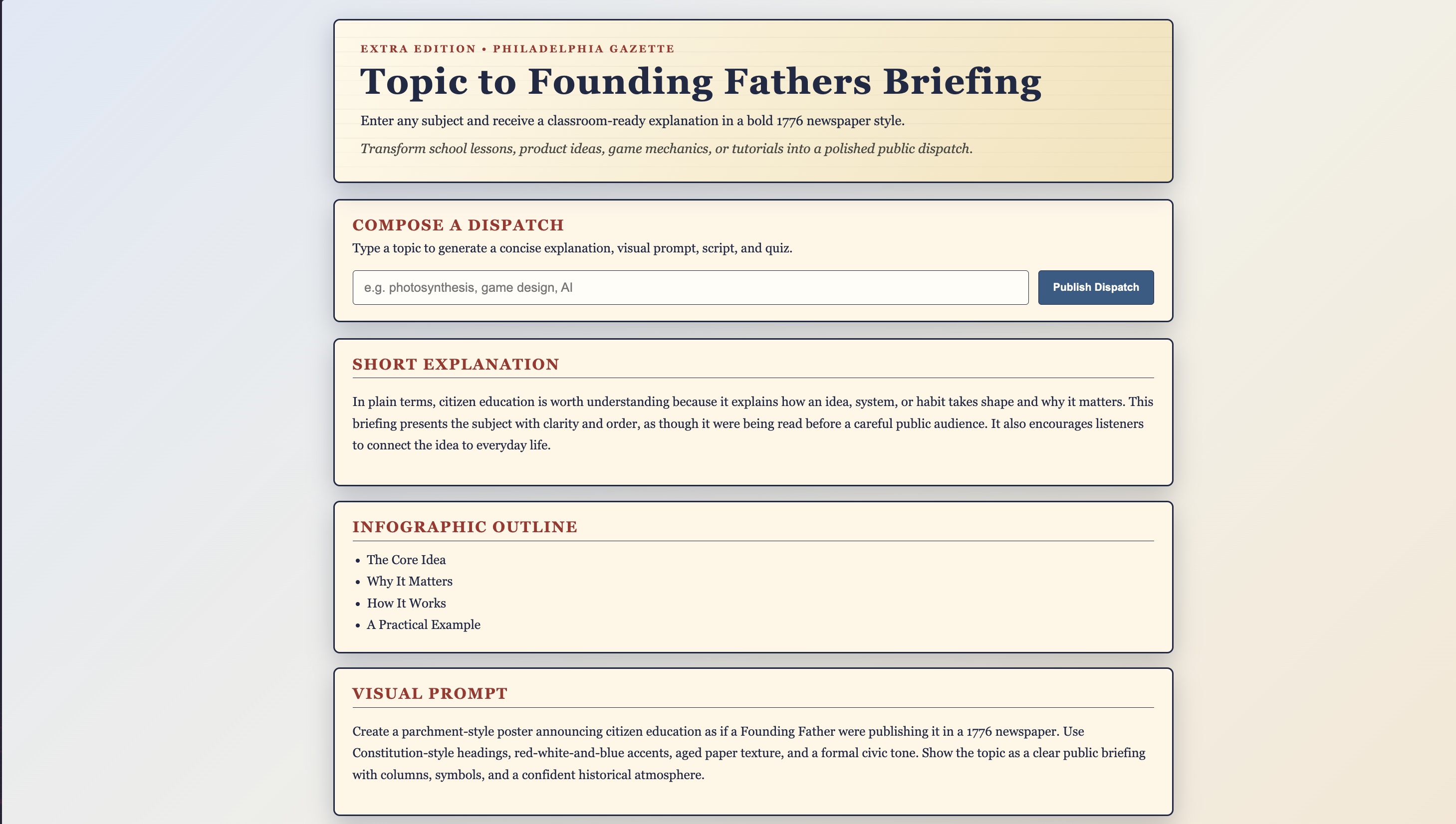
A strong Founding Fathers-style briefing usually includes five key sections:
Short explanation: a concise paragraph that states the topic clearly.
Infographic outline: a simple list of visual stages or ideas.
Visual prompt: a creative image direction that gives the presentation a distinct voice.
Teacher-style script: a spoken explanation written in a calm, classroom-friendly tone.
Quiz questions: a short set of prompts that reinforces the main points.
How to use it
The easiest way to use this style is to begin with a single topic and ask a few simple questions: What is the core idea? Why does it matter? How can I make it visual? What should the audience remember at the end?
Once those answers are clear, the rest of the structure almost writes itself. The format gives the content rhythm, while the historical tone makes it feel distinct.
A final thought
Great communication does not need to be complicated. Often, it only needs a strong frame, a clear voice, and a little imagination. This style offers all three at once.
github: https://github.com/MegaSF/summerAIWeek2
Original source
Canonical Substack URL: https://evanrhea.substack.com/p/how-to-turn-any-topic-into-a-founding.