Source note: Local copy of a Summer Into AI 2026 submission originally published on Substack. Screenshots, video, and audio found in the post body are mirrored locally when publicly accessible; profile and avatar images are intentionally not copied. Read the canonical post.
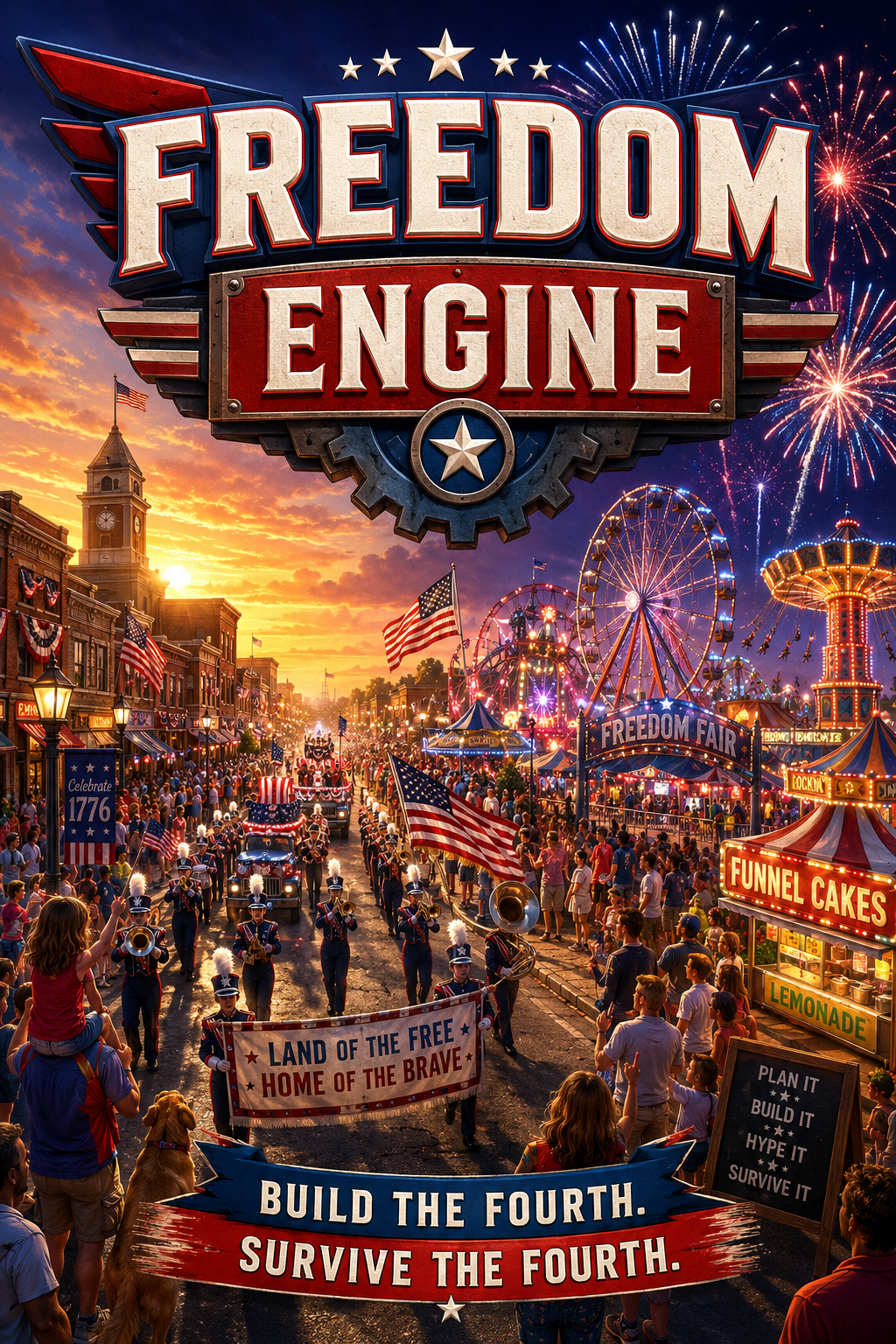
https://github.com/BluntforceRiot/freedom-engine
Play Here! https://bluntforceriot.github.io/freedom-engine/
The Week 2 prompt was Independence Engines.
By this point, I had already built food systems, notebook tyranny, and industrial civic machinery. So naturally, the next question was:
What is the dumbest, loudest, most public version of an independence engine?
The answer was obvious.
This one also had a direct family echo because Kady’s Parade Candy Chaos was already living in the same Fourth-of-July street-world.
Her angle was the good stuff at eye level: parade energy, candy flying, kids tracking the route, public celebration as happy chaos. That is the part people actually remember. The curb. The bag. The scramble. The little sugar economy of a parade crowd.
I wanted to build the adult infrastructure monster underneath that moment.
Because a parade feels spontaneous only when somebody else already solved the route, the traffic, the staging, the crowd flow, the trash, the bathrooms, the heat, the safety plan, and the question of whether Gary is allowed to park the supply truck there.
So Freedom Engine became the backstage goblin cousin of Parade Candy Chaos.
Kady’s game is the parade from the curb.
Mine is the civic machinery sweating behind the bunting.
A Fourth of July festival.
Not the postcard version. Not the clean little “town celebration” stock photo where everyone is smiling, the flags are perfectly folded, and nobody has been standing in a bathroom line long enough to reconsider the Constitution.
I mean the real machine.
The parade route.
The hot dog stand.
The funnel cake line.
The parking lot turning into a civics-themed hostage situation.
The trash cans filling at the speed of national pride.
The fire marshal watching the fireworks plan with the facial expression of a man who has seen too much and trusted too little.
So I built Red, White & Boomtown, which I also think of as Freedom Engine.
The title on the box art is the big idea.
The actual game name is the punchline.
Red, White & Boomtown is a one-day festival-management sim about building the Fourth from the ground up. You place paths, vendors, civic booths, carnival rides, parade pieces, services, and abstract fireworks infrastructure in Liberty Park. Then you try to keep the crowd happy, the budget alive, the traffic moving, the trash under control, the bathrooms functional, and the sky from becoming legal evidence.
This is an Independence Engine because a public celebration is not magic.
It feels like magic when it works.
That is the trick.
You show up with your family. The band plays. Kids wave flags. Someone buys lemonade. Someone drops mustard on a shirt they just bought. The parade rolls through town. The Ferris wheel lights up. The fireworks go off. Everyone goes home saying, “That was nice.”
Nobody says:
“Excellent multi-system coordination between vendor supply, foot traffic, sanitation capacity, safety coverage, viewing geometry, parking throughput, crowd mood, weather response, parade routing, and fireworks permitting.”
But that is what happened.
That is the engine under the bunting.
That is what I wanted to turn into a game.
A festival is freedom wearing a logistics vest.
The surface is all noise and color. Flags, food, fireworks, brass bands, carnival lights, kids with sticky hands, adults pretending they are not excited about funnel cake even though absolutely everyone is excited about funnel cake.
Underneath, it is a civic machine.
Can people get in?
Can they move around?
Can they eat?
Can they find water?
Can they find a bathroom before the situation becomes philosophical?
Can trash leave the park faster than it appears?
Can emergency crews reach trouble?
Can the parade route create joy without blocking the entire bloodstream of the town?
Can the fireworks finale be spectacular without making the fire marshal ascend into a legal thundercloud?
That is the game.
You start in Morning Setup, when the field still looks innocent and the committee is using phrases like “manageable crowd.” This is when you build the boring stuff, which is always the important stuff. Paths. Entrances. Parking. Shuttle stops. Water stations. Trash cans. Bathroom rows. First aid. Fire crew staging.
The boring stuff is where civilization hides its skeleton.
Then comes the Afternoon Crowd Surge.
Families arrive hungry, thirsty, warm, optimistic, and gravitationally attracted to the exact part of the park you forgot to connect with paths.
Now your choices start talking back.
A hot dog stand brings revenue and food capacity, but it also creates trash and lines.
A funnel cake stand creates joy, money, and a delicious powdered-sugar weather system, but now the ground looks like a dessert crime scene and everyone is standing in the same choke point.
Lemonade reduces heat.
Ice cream boosts joy.
BBQ feeds people, makes money, and quietly asks whether you remembered fire coverage.
Carnival rides draw crowds, but they need power, safety, maintenance, and space.
A music stage makes the event feel alive, but it also creates noise and crowd clustering.
Everything is good.
Everything is also a problem.
That is the design rule I keep coming back to with these Independence Engines projects.
No clean levers.
No “click this to solve freedom.”
If a system produces value, it also produces pressure.
Food produces trash.
Spectacle produces risk.
Crowds produce money and chaos.
Parades produce civic pride and traffic nonsense.
Fireworks produce awe and paperwork.
Bathrooms produce no glory whatsoever, yet if you do not build enough of them, your festival collapses into the most preventable form of civic betrayal.
Nobody wants to admit this, but bathrooms are a pillar of democracy.
You can put that on a coin.
The third phase is Parade Hour, when civic pride rolls directly through your infrastructure and blocks whatever you failed to plan around.
A parade is a beautiful thing until you remember roads are also used for movement.
That is exactly why it belongs in the game. A parade is not just decoration. It is a moving policy decision with tubas. You need staging. You need routes. You need viewing areas. You need enough flow that people are not trapped behind a classic car line wondering whether liberty includes access to lemonade.
The parade pieces are fun: veterans float, fire truck float, classic cars, staging zones, routes. They add pride and spectacle, but they occupy space and bend movement around themselves. The town wants the parade. The map has opinions.
Then comes Evening Rush.
This is where the festival turns into a pressure cooker with a marching band soundtrack.
The crowd is bigger. Heat matters. Trash matters. Food matters. Bathroom pressure matters. Noise matters. Supply matters. Safety matters. The budget is no longer a number, it is a small animal hiding under the desk.
This is the phase where the player starts to see the whole machine at once.
The hot dog stand was good.
The funnel cake stand was good.
The Ferris wheel was good.
The parade was good.
The fireworks plan was good.
But did you build enough paths?
Did you overbuild revenue and underbuild services?
Did you make a beautiful festival shaped like a clogged artery?
Did you put the fireworks launch zone somewhere sensible, or did you create an abstract insurance poem?
Did you give people joy and forget to give them exits?
This is what I love about the project. It takes a day that normally gets reduced to flags and fireworks and reveals the public infrastructure underneath it.
A celebration is not just a feeling.
A celebration is a system that lets people feel that feeling safely together.
That matters.
Because when we talk about independence, we usually talk in giant words. Liberty. Freedom. Nation. Rights. Destiny. All the brass-section nouns.
But actual freedom, the kind people experience in public, often depends on whether the route is clear, the lights work, the trash is handled, the water is available, the crowd is safe, the family can find each other, and the plan survives contact with weather.
Freedom is not only the speech.
Freedom is also the service lane behind the lemonade stand.
Then comes the Fireworks Finale.
This is where the game stops being polite.
The finale does not care what you intended. It scores what you built.
Spectacle. Readiness. Viewing. Safety. Fire risk. Permit pressure. Weather. Chaos. Fire marshal confidence. Crowd joy. Flow. Cleanliness. Bathroom pressure. Money. Civic pride.
The newspaper has thoughts.
Several of them are fair.
That final recap matters because a public event always turns into a story. If it works, people remember the fireworks. If it fails, people remember the traffic, the heat, the bathroom line, the stockout, the parade bottleneck, the trash avalanche, or the moment the fire marshal looked at the setup and spiritually left the county.
That is why the game includes local-radio and Gazette-style event blurbs. Heat waves. Stockouts. Fire marshal warnings. Parking gridlock. Parade detours. The event is not just numbers moving behind the curtain. It is a public thing, and public things become public stories.
The town experiences the machine.
Then the town narrates the machine.
That is a civic engine too.
The policies let you tilt the whole festival before and during the run. Budget priority. Fireworks enforcement. Vendor mix. Parade ambition. Security style. Service level.
These are not just flavor buttons. They are different ways of saying what kind of town you are trying to be for one day.
Do you go spectacle-first and risk the boring systems?
Do you go safety-first and risk making the festival feel like a laminated rulebook?
Do you chase vendor revenue?
Do you favor local vendors?
Do you overprepare services like a person who has seen one county fair go wrong and vowed never again?
Do you run light security because you want a relaxed celebration, or heavy security because chaos has begun writing its memoir?
Every choice is a tradeoff.
That is the whole machine.
The Fourth of July is a perfect subject for this because it is both symbolic and extremely physical.
Symbolically, it is independence, patriotism, fireworks, flags, parades, music, all of it.
Physically, it is asphalt, grass, tents, extension cords, portable bathrooms, vendor permits, crowd control, first aid, lost-child tents, trash pickup, fire barriers, traffic routing, and someone named Gary trying to reverse a supply truck between two barricades while a marching band is tuning nearby.
The symbol only works because the physical layer works.
That is where games can teach better than speeches.
If I write, “Public celebration depends on infrastructure,” that is true, but it sounds like something printed on the back of a municipal grant binder.
If I make you place funnel cake too far from the paths, forget enough trash cans, underbuild bathrooms, and watch your joy score get mugged by reality, now you understand.
The game did not lecture you.
It made you mayor of a disaster burrito.
Congratulations.
You learned.
I used AI the same way I used it on the other submissions: as a workshop partner, not a replacement brain and not a runtime gimmick.
ChatGPT helped shape the concept, the framing, the jokes, and the system logic. Codex helped with implementation, integration, verification, and packaging. The game itself is a local browser app. No accounts. No backend. No analytics. No telemetry. Saves stay in local browser storage.
That was important here too.
A game about public trust, civic systems, and local celebration should not require a login ceremony or secretly phone home from behind the fireworks booth.
Also, the fireworks are intentionally abstract game objects. This is not a fireworks construction manual. Nobody needs tactical funnel cake or operational sparkler doctrine. It is a festival sim, not a county lawsuit generator.
The implementation is a clean Vite, TypeScript, and Three.js browser prototype. The visuals are procedural and symbolic. The goal was not final commercial art. The goal was a playable public artifact that makes the system readable.
That is the through-line for all of these Week 2 builds.
Small enough to play.
Weird enough to remember.
Concrete enough to mean something.
Food Engines said food independence is not just crops. It is storage, preservation, kitchens, markets, and trust.
Manifest Notebooky said writing freedom becomes absurd when the tool forces your private thought through ideological autocorrect.
Engines of Independence said a town is a machine made of power, transport, money, labor, media, public works, and consequence.
Red, White & Boomtown says even celebration is infrastructure.
You do not get the magic without the machine.
The band does not march through vibes.
The crowd does not flow through patriotic intention.
The bathrooms do not manifest because a committee used the word “community.”
The fireworks do not become safer because everyone is feeling festive.
The Fourth has to be built.
That is why the cover says Freedom Engine.
Because that is what this is.
A ridiculous, colorful, public, noisy little freedom engine with funnel cakes in one hand and a fire extinguisher in the other.
Build the Fourth.
Feed the crowd.
Keep the sky from suing you.
And never, ever underestimate the civic importance of bathroom math.
Original source
Canonical Substack URL: https://safetylast.substack.com/p/freedom-engine-red-white-and-boomtown.