Source note: Local copy of a Summer Into AI 2026 submission originally published on Substack. Screenshots, video, and audio found in the post body are mirrored locally when publicly accessible; profile and avatar images are intentionally not copied. Read the canonical post.
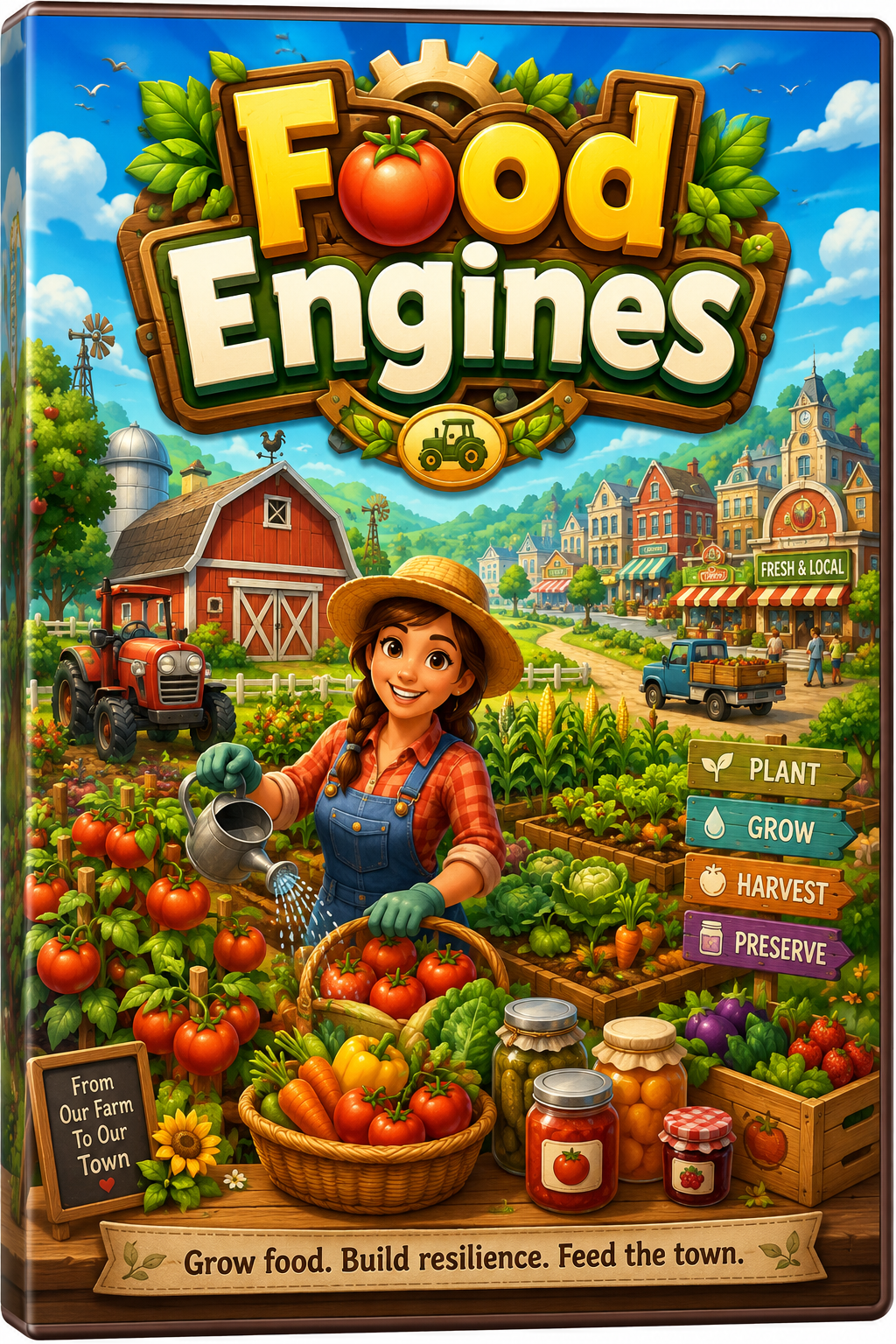
Download here. https://github.com/BluntforceRiot/food-engines
Play here! https://bluntforceriot.github.io/food-engines/
The Week 2 prompt was Independence Engines.
That phrase can go wrong fast.
You can almost hear the beige dashboard forming in the walls. Resilience metrics. Stakeholder alignment. Civic activation. A little icon of a wrench wearing a flag pin. Somewhere, a committee reaches for a stock photo of children holding vegetables and the room temperature drops four degrees.
I did not want that.
I wanted an actual engine.
Not a slogan. Not a fireworks GIF wearing LinkedIn shoes. Not a grant proposal that says “community” eighteen times and somehow never mentions lunch.
So I made Food Engines.
The fun part of Week 2 was seeing how many different shapes people found inside the same phrase. Eric’s Independence Engines prompt was broad enough that it could become a founder-voice experiment, a country-as-software metaphor, a parade game, a food system, or a whole industrial town simulator without anybody technically leaving the assignment.
That made me want Food Engines to stay humble on purpose.
Myles’s Dependency Day and Qwen Franklin energy went toward civic language and founding-era weirdness. USA OS took the nation-as-system idea in a much bigger architectural direction. Kady’s Parade Candy Chaos grabbed the public celebration angle from street level, candy level, kid-chaos level.
Food Engines went lower than all of that.
Dirt level.
Pantry level.
Lunch level.
Before the town can write manifestos, install an operating system, hold a parade, or argue about civic destiny, somebody has to grow food. Somebody has to water it. Somebody has to preserve it. Somebody has to turn the crop into something the school, the firehouse, the diner, the pantry, and the neighborhood can actually use.
That was the branch I wanted: independence as the quiet food machine underneath the louder American machinery.
Food Engines is a bright little browser farm-grid strategy game about food independence. You plant crops. You water them. You harvest them. You build the systems behind a town that can feed itself. Then, because the universe has a sense of humor and hates your lettuce, weather and demand start leaning on you.
The surface is cozy.
You have tomatoes, corn, beans, potatoes, lettuce, wheat, apples, and pumpkins. You click dirt plots. You grow food. You fill baskets. You watch a little farm become useful. It has that old social farm-grid serotonin loop where your brain goes, “Yes, thank you, I have successfully interacted with a vegetable.”
But underneath the cute stuff, Food Engines is a small civic machine.
You get 21 days. Each day gives you 6 actions. Your farm is a grid. Your water is limited. Crops take time. Food spoils. Weather changes. The town still wants to eat.
The school lunch board needs tomatoes and wheat.
The firehouse wants chili.
The diner needs pie.
The pantry wants shelf-stable confidence before the final week.
That is the trick.
A tomato by itself is a crop.
A tomato connected to soil health, rain barrels, seed saving, soup pots, canning jars, root cellars, farm stands, school lunch, and local trust?
That is an engine.
That is what I wanted the game to model. Independence is not one heroic object sitting in the middle of town with a flag stuck in it. It is not “we have one generator, therefore civilization has been solved.”
Independence is boring in the most important way.
It is redundancy. It is storage. It is local skill. It is people knowing who has what, who needs what, and what can be preserved before summer turns into winter and everyone starts pretending crackers are a meal.
So Food Engines has actual engines.
Compost Bin.
Rain Barrel.
Well.
Seed Saving Shed.
Greenhouse.
Soup Pot.
Bakery.
Community Kitchen.
Cannery.
Root Cellar.
Roadside Farm Stand.
CSA Chalkboard.
County Market Stall.
All tiny systems. All making the town less fragile. All doing the quiet work that never gets a statue, because apparently we only build statues for people with swords and not whoever figured out pantry math.
The game looks cheerful because it should.
I did not want “food independence” to feel like a bunker catalog written by a man named Dale who owns fifteen flashlights and trusts none of them.
This is not apocalypse fantasy.
This is county fair, school cafeteria, diner coffee, baseball concession stand, pantry drive, firehouse chili, harvest supper, and neighbors slowly realizing that the potato pile is not a warning.
It is a plan.
The original seed of the idea was simple: take that old casual farm-grid feeling, the kind of game where you plant tomatoes and come back to harvest them, and point it at something more useful.
Not Stardew Valley.
Not a giant farming RPG.
Not a cozy life simulator where the mayor gives you emotional homework.
More like the old Facebook farm-game loop: plant, wait, harvest, repeat. But instead of turning that loop into endless expansion and fake currency, use it to show food systems.
Because planting food is only the visible part.
The engine is everything that happens around it.
Can you water enough?
Can you avoid waste?
Can you preserve surplus?
Can you feed the school?
Can you fill the pantry?
Can you turn crops into meals?
Can you build enough local capacity before the town needs it?
That is the game.
And yes, it is tiny. On purpose.
AI will absolutely try to inflate a prototype into a countywide edible Civilization if you let it. One minute you are balancing tomatoes and rain barrels. The next minute it wants municipal bonds, tractor depreciation, deer migration, supply-chain diplomacy, and a screen where the bakery threatens sanctions.
No.
Tiny game first.
Finish the loop.
Make the thing playable.
That became one of the main rules while building Food Engines. Keep it small enough to understand, but deep enough that the player can feel the system. A 21-day run. Limited actions. Visible tradeoffs. Simple crops. Clear town requests. Engines that make sense without needing a manual written by a turnip lawyer.
I used AI as a workshop partner, not as a vending machine.
ChatGPT helped shape the idea. Codex helped implement, review, and polish. The important part was keeping the boundaries tight. Static browser app. No backend. No accounts. No analytics. No telemetry. No remote AI calls at runtime. No copied farm-game assets. No commercial farm-game names, art, UI, sounds, characters, or social mechanics.
Just an original little web game about growing food and feeding a town.
That mattered to me because this competition is about public artifacts, not just private experiments. I wanted something you could open in a browser and understand quickly. Something a judge could play. Something a kid could click around in. Something that looks friendly, then quietly starts teaching the player that independence is not a vibe.
It is logistics.
It is timing.
It is storage.
It is water.
It is preservation.
It is community trust.
Food Engines is cute because vegetables are allowed to be cute.
But the idea underneath is serious.
A fed town is not built out of speeches. It is built out of systems that compound. One rain barrel does not save you. One compost bin does not solve hunger. One farm stand does not create resilience.
But connect them together and something changes.
Now the town has stored food.
Now the town has seed systems.
Now water is not a single point of failure.
Now surplus can become soup.
Now harvest can become winter food.
Now the pantry is not a wish.
It is an engine.
That, to me, is the point of Independence Engines.
Practical local agency.
Not symbolism.
Not another dashboard full of civic beige.
A fed town is built out of small systems that keep working after the speech ends.
Food Engines is my bright little browser-game version of that idea.
Plant the food.
Build resilience.
Feed the town.
And for the love of all that is holy, respect the strategic importance of tomatoes.
Original source
Canonical Substack URL: https://safetylast.substack.com/p/food-engines-i-built-a-tiny-farm.