Source note: Local copy of a Summer Into AI 2026 submission originally published on Substack. Screenshots, video, and audio found in the post body are mirrored locally when publicly accessible; profile and avatar images are intentionally not copied. Read the canonical post.
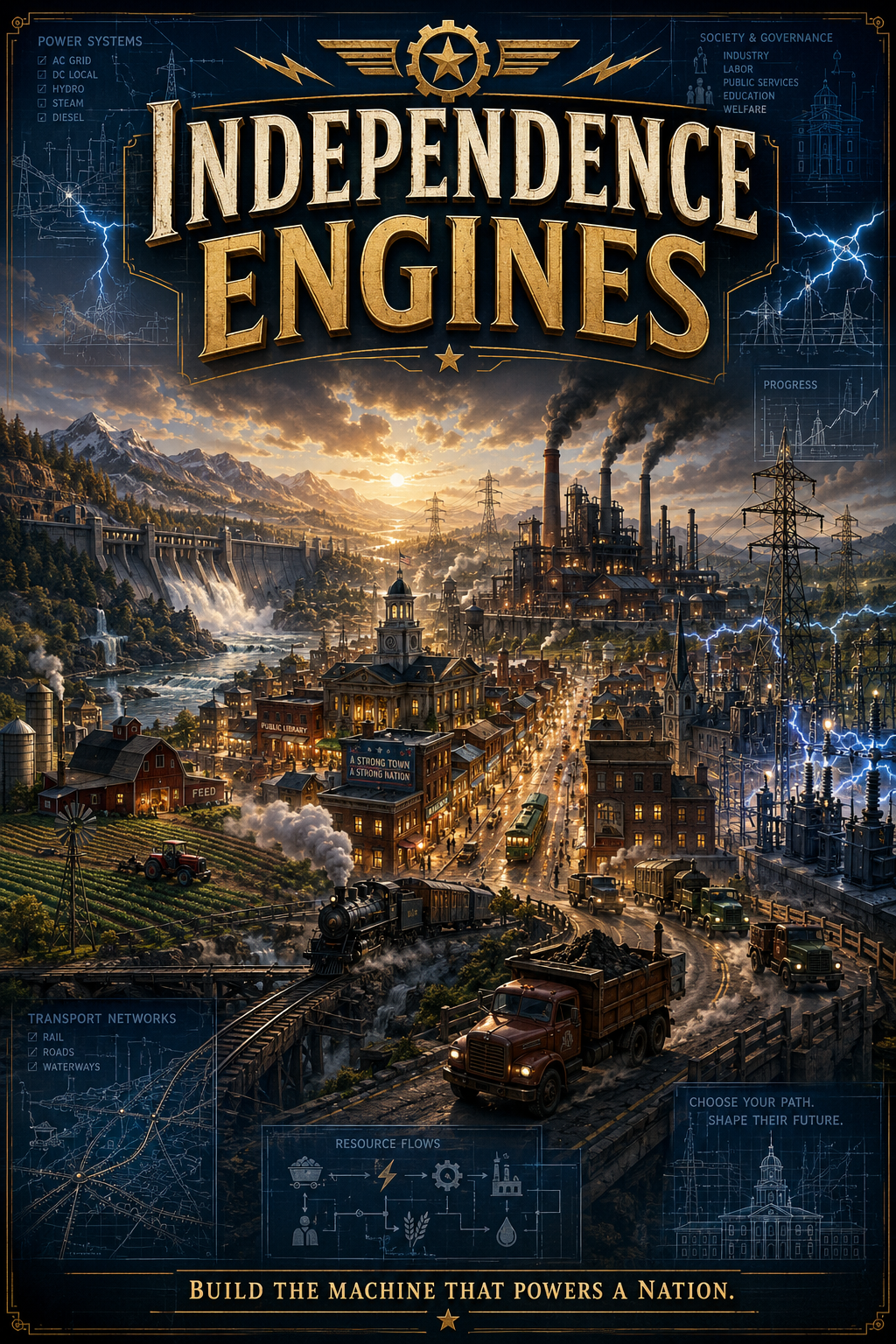
Download here:https://github.com/BluntforceRiot/engines-of-independence
Play here! https://bluntforceriot.github.io/engines-of-independence/
The Week 2 prompt was Independence Engines.
I may have taken that personally.
Eric’s Week 2 framing made the phrase Independence Engines feel less like a theme and more like a dare. Not “make something about independence.” Build the thing underneath it. Build the machinery. Show the conversion layer.
That is why USA OS was an interesting neighbor in the same conceptual town. A country-as-operating-system metaphor goes big immediately: laws, processes, interfaces, protocols, governance, the national machine as software.
I wanted to go one layer dirtier.
Not the OS.
The hardware under the OS.
Power. Roads. Rail. Coal. Water. Farms. Banks. Newspapers. Labor. Public works. Corruption. Trust.
If USA OS points at the operating logic of a country, Engines of Independence points at the industrial basement full of boilers, ledgers, wires, freight schedules, town meetings, bond debt, and one sweating official saying, “We can afford the bridge if nothing catches fire.”
Which, naturally, means something is about to catch fire.
Because the phrase does not just sound like a theme. It sounds like a challenge thrown through a factory window.
An engine is not a slogan. An engine converts one thing into another.
Coal into power.
Taxes into public works.
Banks into credit.
Credit into growth.
Growth into panic.
Newspapers into belief.
Belief into legitimacy.
Legitimacy into trust.
Trust into civilization, assuming nobody sets the bank on fire first.
That was the idea behind Engines of Independence: build a town as a machine of civilization. Not a cute little town where every problem politely waits in a menu. A town where every system you build solves one problem and creates another, because that is what infrastructure does when it stops being a speech and starts being real.
You start with a small charter town in 1880.
A little cash.
Some roads.
Some farms.
Some housing.
A Main Street.
A town hall.
The kind of place that looks peaceful right before someone discovers credit expansion and coal smoke.
Then you start building.
Roads. Rail. Farms. Factories. Power plants. Depots. Banks. Newspapers. Saloons. Union halls. Water pumps. Public works. Civic services. Parks. Shadow buildings. The town grows. The map fills in. The machine starts to hum.
Then the machine starts asking for payment.
Coal gives you power, but also pollution and fire risk.
Rail gives you freight, but also industrial pressure.
Public works give you resilience, but also debt.
Banks give you liquidity and growth, but also panic.
Newspapers give you public belief, but also scandal.
Saloons give you revenue and social glue, but also disorder.
Prohibition tries to clean things up, then accidentally invents the shadow economy with a badge and a pamphlet.
That is the whole design philosophy.
No clean levers.
No magic civic button.
No “click here to achieve national greatness” upgrade with a bald eagle animation and a boardroom-approved font.
Every engine has exhaust.
That is what I wanted the player to feel. Independence is not just having a flag. Independence is having the systems required to keep the lights on, keep food moving, keep credit trusted, keep workers alive, keep newspapers useful, keep public works funded, and keep the town from turning into a debt-powered chimney with a courthouse attached.
It is not glamorous.
It is coordination.
It is maintenance.
It is tradeoffs.
It is somebody, somewhere, realizing that the bridge is not a metaphor. It is a bridge. If it collapses, the town does not get to publish a values statement and walk across vibes.
So Engines of Independence became a strategy game about pressure.
The player chooses power doctrine, transport doctrine, and money doctrine. That sounds dry until you realize each doctrine is basically a loaded revolver sitting on the mayor’s desk.
Do you trust hard money?
Congratulations, prices are stable and outside trade respects you, but credit is tight and expansion slows down.
Do you lean into silver and bimetal?
Farmers and debtors breathe easier, frontier growth improves, and faction conflict starts warming up like a drunk trombone.
Do you use public paper money?
Public works get easier. Emergency spending gets easier. Monetary trust starts sweating through its shirt.
Do you expand bank credit?
Housing, factories, and commerce grow. Speculation grows too, because apparently humans cannot see a financial instrument without trying to turn it into a haunted carnival ride.
Do you issue municipal bonds?
Now you can build the big stuff before you can fully afford it.
Excellent.
The future is impressed.
The future also wants debt service.
This is the part I really liked building conceptually. Money is not just a number in the corner. It is an engine. It converts trust into trade. It converts credibility into expansion. It converts panic into collapse at terrifying speed.
That is more interesting than “gold good, paper bad” or “credit good, restraint bad.” The game is not trying to hand the player one ideology and say, “Here is the correct answer, citizen, please frame it above your water heater.”
The game is trying to say:
All of these systems work.
All of these systems break.
Pick your machine.
Then live inside the consequences.
That is also why the town has policies instead of just buildings. Taxes, public works, regulation, alcohol, utility ownership, labor, media, banking. Those are not decorative toggles. They are steering mechanisms. They shape what kind of town you are building and what kind of problem will eventually arrive wearing a hat.
Because there is always a problem wearing a hat.
Industrial growth brings jobs, but it can also bring pollution, injury, unrest, and fire.
Labor organization can stabilize a town or sharpen conflict.
Newspapers can expose corruption or spread panic.
Courts and bank examiners can restore confidence, unless you waited until the whole economy was already doing a swan dive into a coal chute.
Public works look boring until they are the only reason your town survives the next shock.
That last one matters.
Public works are not sexy. Nobody makes an action movie where the hero says, “We need sewer bonds, now!” and then dives sideways through a window while holding a clipboard.
But in real civic life, public works are where the dragon sleeps.
Water. Roads. Sewers. Fire codes. Utility grids. Courts. Clinics. Settlement houses. Rural electric co-ops. The boring stuff is the machine. The boring stuff is why people can wake up, go to work, send kids to school, drink water, get paid, buy bread, and not spend the afternoon improvising cholera policy.
So the game treats boring things as decisive.
That felt right for Independence Engines.
The independence part is not only rebellion. It is capacity. A town is not independent because it declares itself rugged. A town is independent because it can feed people, move goods, generate power, survive shocks, finance repairs, settle disputes, and keep enough trust in the system that everyone does not start hoarding nails and accusing the newspaper boy of monetary sabotage.
A strong town is a machine.
A fragile town is a slogan with windows.
I also wanted the game to have that old industrial board-game feeling where the map itself becomes a diagnosis. Put houses near parks and civic services, and people do better. Put homes next to factories, coal plants, fuel depots, and heavy industry, and the town starts paying in health, fire risk, pollution, and trust. Cluster banks, telegraph offices, newspapers, courts, and town halls near Main Street, and the market starts to feel more real. Put farms near roads, rail stations, grain elevators, and diesel depots, and suddenly food is not just grown. It moves.
That is an engine too.
Placement is policy wearing boots.
The map is not supposed to be a perfect simulation. It is supposed to make the relationships visible. Factories need freight. Farms need roads. Power needs resilience. People need services. Banks need trust. Newspapers need events. The town needs all of it, and all of it wants money.
Money, naturally, wants a throne.
The player advances month by month, or runs a year when they feel brave, reckless, or legally mayoral. The town changes. The pressure board updates. The Town Desk advisor tells you where the machine is groaning. Charter goals give milestones. Civic projects offer permanent changes. The Engine Gazette reports what happened.
That Gazette is one of my favorite parts because it turns the simulation back into public memory.
A town does not only run on numbers. It runs on stories about the numbers. A bank panic is not just liquidity falling. It is people reading about liquidity falling. A strike is not just labor pressure. It is a headline. A scandal is not just corruption. It is the moment corruption becomes common knowledge.
Information is an engine.
Newspapers convert events into belief.
They also convert rumor into stampede if the town is already unstable enough.
That is why the newspaper system had to be deterministic and local. No online AI call pretending to be a reporter. No model improvising civic prophecy in the attic. The Gazette is a local template system tied to the town’s state. It reacts to what your town is doing. It gives the run a public record.
That is the right kind of artificial newspaper for this project: fake, local, deterministic, and somehow still less embarrassing than half the modern internet.
The run eventually ends in a final ledger.
That also felt necessary. A city-building game can leave you staring at a map forever, like a god with zoning fatigue. I wanted a run to close. I wanted the town to print its own ending. What powered your independence? What were your strongest engines? What were your worst pressures? What kind of town did you actually build, not what kind did you imagine during the first five optimistic minutes?
That final ledger is the receipt.
It is the game saying:
Here is your machine.
Here is what worked.
Here is what rotted.
Here is what you borrowed.
Here is what you ignored.
Here is the town you made.
Very rude. Very useful.
This was also the biggest of my Week 2 submissions in spirit. Food Engines was the practical local farm loop. Manifest Notebooky was the satirical writing-tool goblin with fireworks in the spellchecker. Engines of Independence is the heavy civic machine. It is the one where the whole town becomes the object.
Not one engine.
All the engines.
Power, transport, money, labor, media, public works, corruption, trust.
That can get too big fast. AI will happily help you scope-creep a prototype until it requires a legislative staff, three PhDs, and a loading screen that says “calculating regional vibes.” So I had to keep the goal clear:
Make the systems readable.
Make the town playable.
Make every benefit create pressure.
Make the pressure feel civic, not random.
The game uses procedural placeholder geometry and a Three.js board. It is not pretending to be final commercial art. It is a public browser prototype, built to show the idea working. I care more that the town has understandable systems than that every building has artisanal chimney lint.
This is a competition artifact, not a 900-hour industrial management simulator designed to make Steam reviewers say, “Very promising, but insufficient sewer granularity.”
The AI usage followed the same pattern as the other submissions. ChatGPT helped with concept development, design direction, review framing, and public-readiness feedback. Codex helped with implementation, integration, local verification, and packaging.
But the game does not call AI at runtime.
No backend.
No accounts.
No analytics.
No online leaderboard.
No remote model sitting behind the Gazette whispering about substation failures.
The simulation runs locally. The event copy is local. Saves stay in the browser. The machine is self-contained.
That boundary matters because the whole thing is about trust. You cannot make a game about civic systems, public legitimacy, money, and institutional pressure, then quietly shove the player into a data blender behind the courthouse.
That would be thematically consistent, actually.
But evil.
So no.
Static browser game. Local systems. Clear attribution. Playable prototype.
The starting point was an open-source Three.js/Vite scaffold, then the user-facing identity, theme, UI language, rules, and simulation were replaced for this original competition prototype. That is the kind of detail I like to keep visible because public artifacts should have receipts. I do not want the civic-machine game to have secret machinery. That would be a little too on the nose, and the nose already has a telegraph office on it.
What I ended up with is not a game about whether industry is good or bad.
It is not a game about whether banks are heroes or villains.
It is not a game about whether public works are noble or wasteful.
It is not a game about whether newspapers save democracy or light it on fire.
It is a game about systems.
Systems that convert.
Systems that compound.
Systems that leak.
Systems that build the town while slowly inventing the next crisis.
That is what makes independence hard.
It is not the first declaration.
It is the maintenance schedule after everyone goes home.
Can your town power itself?
Can it move goods?
Can it finance growth without detonating trust?
Can it regulate industry without choking it?
Can it build public works without drowning in debt?
Can it handle labor conflict without becoming a factory-shaped fistfight?
Can it keep newspapers useful instead of panic-powered?
Can it survive its own success?
That is the machine.
And that, to me, is the real meaning of Independence Engines.
Independence is not just freedom from a ruler. It is the ability to operate the systems that keep a community alive.
The rail.
The road.
The wire.
The water.
The bank.
The ledger.
The paper.
The pump.
The court.
The school.
The power plant.
The union hall.
The town hall.
The public works project everybody complained about until it saved them.
Engines of Independence is my attempt to turn that into a browser game.
Build the machine that powers a nation.
Then find out what the machine costs.
Original source
Canonical Substack URL: https://safetylast.substack.com/p/engines-of-independence-i-built-a.