Source note: Local copy of a Summer Into AI 2026 submission originally published on Substack. Screenshots, video, and audio found in the post body are mirrored locally when publicly accessible; profile and avatar images are intentionally not copied. Read the canonical post.
Money is only independent if it moves.
That sounds obvious until you start thinking about what money actually is. Not the little rectangle in your wallet, or the number hiding inside your banking app, or the haunted grocery receipt that says eggs have become a luxury artifact. Money is a trust object. It only works if people believe someone else will accept it later.
That belief does not live in the paper.
It lives in the route.
For Summer into AI Week 2: Independence Engines, I wanted to build a game about independence from a different angle. Not independence as one heroic speech, not independence as a flag waving over a marble building, and not independence as a beige dashboard with “community empowerment” written on it by someone trapped in a grant proposal.
I wanted the machinery.
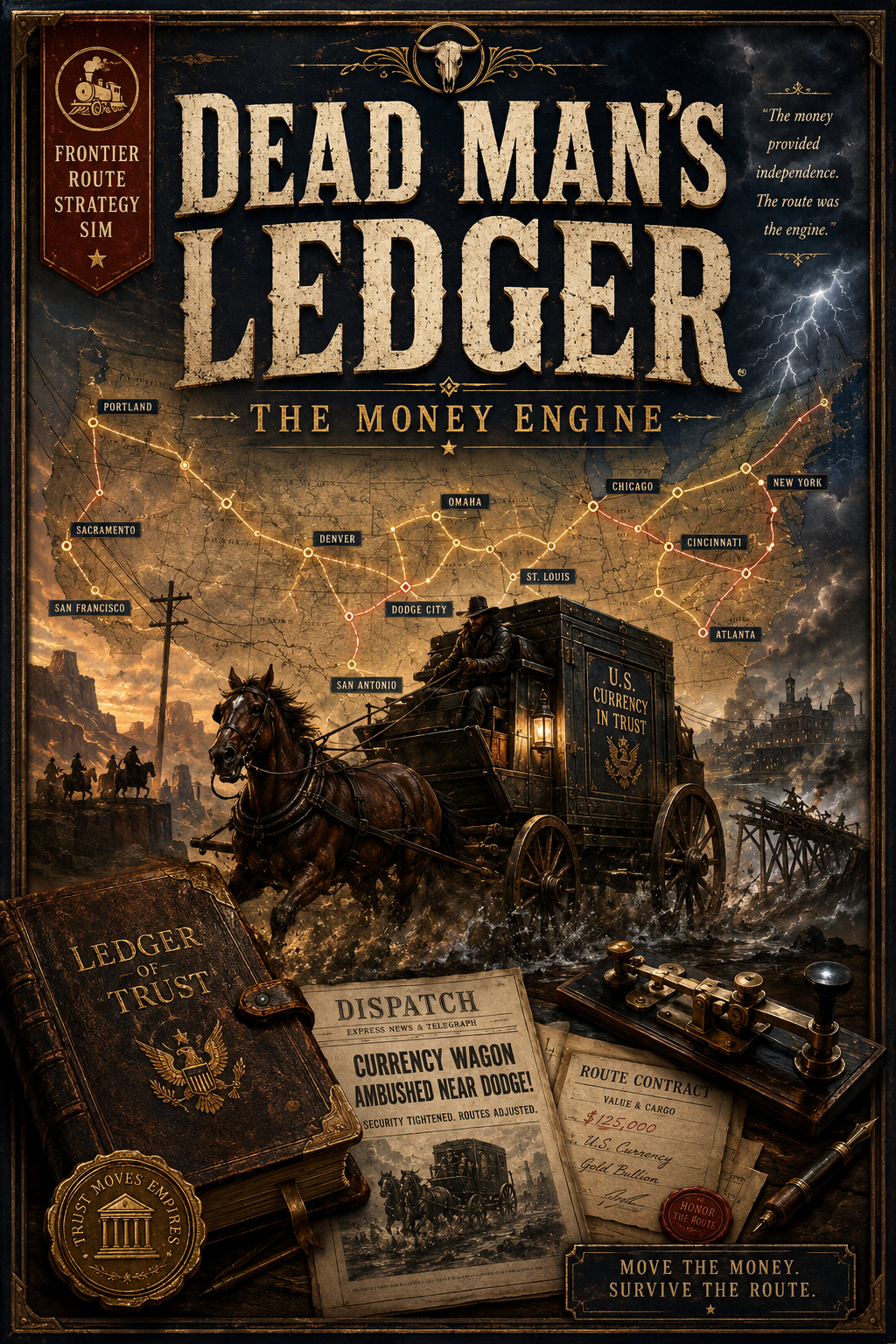
So I built Dead Man’s Ledger: The Money Engine, a browser board-game strategy sim about moving valuable currency through dangerous American routes.
The premise is simple:
The money provided independence.
The route was the engine.
The frontier does not care about your monetary theory
In Dead Man’s Ledger, you are not printing money in a quiet room and declaring the problem solved. You are trying to keep money trusted by physically moving it across a hostile route network.
A contract gives you an origin, a destination, cargo type, cargo value, delivery fee, trust weight, and leg limit. You choose a dispatch office, select routes, gather intelligence, assign protection, and hope your shipment survives long enough to complete the delivery.
The board looks like an antique ledger map woke up in a strategy game.
There are cities, route lines, contract corridors, express routes, danger estimates, and a selected-route ledger showing what you know, what you suspect, and what you are about to risk. The map is generated from open geodata rather than invented fantasy geography, because if the game is about routes, the routes should feel anchored to the actual country.
The core loop is:
Choose a reachable route.
Scout, telegraph, insure, delay, hire guards, send repair crews, set a decoy strongbox, borrow credit if desperate, or repay debt if you are trying to stop your financial life from sounding like a banjo thrown down a staircase.
Then dispatch.
Sometimes the route is clean.
Sometimes the weather hates you.
Sometimes the bridge is gone.
Sometimes the telegraph line is cut.
Sometimes an inside leak makes your “secure shipment” about as secure as a screen door on a submarine.
Sometimes the rumor was bait, and now you are poorer in a more educated way.
Information is not protection
One of the design decisions I liked most was separating intelligence from counters.
Scout Ahead and Telegraph Report can reveal danger, but they do not magically solve it. Knowing there is an ambush is useful. It is not the same thing as hiring guards. Knowing the wire office has bad news is useful. It is not the same thing as repairing the line, delaying the shipment, or insuring the cargo.
That difference matters because a lot of games treat information as a magic wand. You click “investigate,” the fog clears, and suddenly your little wagon is blessed by the gods of logistics.
In Dead Man’s Ledger, information is just information. It can reduce ignorance, but it does not erase risk.
Local Tips are even messier. A station rumor might be useful, incomplete, false, or bait. The game does not hand you a bright red sticker that says “THIS UNCLE IS LYING.” You get a scrap of possible knowledge and decide whether to act on it.
That felt right for the theme.
Currency is trust. Routes are trust. Intelligence is trust. Debt is trust with teeth.
The whole game is a machine made of things people only believe in until enough wagons fail to arrive.
Express routes are shiny knives
Express routes pay better, but they roll two incident checks.
That sounds like a simple risk/reward mechanic, and it is, but it also creates some delicious little panic moments. The route looks good. The money is good. The leg count is tight. The destination is sitting there like a smug little dot on the map. You know you should probably take the standard route, but the express line is glowing at you with that casino-floor energy.
You can prepare for it. You can scout. You can telegraph. You can hire guards. You can insure the cargo.
And then the first incident is handled cleanly.
Great.
Then the second incident punches you in the ledger.
That is the kind of failure I wanted. Not random mush. Not “you lose because the game sneezed.” A readable failure. You can look at the result card and see what happened, what helped, what failed, what it cost, and whether your decision made sense before the road ate you.
[Image: compact result ledger screenshot]
The game’s result cards show route summary, threat, counter results, settlement rows, debt movement, deadline penalties, liability, trust, reputation, and score changes. It is intentionally ledger-heavy because the game is called Dead Man’s Ledger, not Vibes Wagon Deluxe.
If your financial engine explodes, the least it can do is itemize the shrapnel.
The money engine runs on trust, not cash
Cash matters, obviously. If you run out of money, the board stops pretending you are a serious person.
But the game is not just about cash.
Reputation matters.
Currency Trust matters.
Outlaw Pressure matters.
Debt matters.
Cargo value matters because it drives liability and public consequence. You are paid a commission or delivery fee, not the full shipment value. That means a successful delivery can be worth a lot, but a failure can hurt much more than the fee you were chasing.
This is where the “Independence Engines” theme really clicked for me.
A currency is not independent just because someone printed it. A town is not economically independent because a policy exists somewhere far away. Payroll has to arrive. Merchants have to accept the paper. Routes have to stay open. Someone has to keep the system moving through weather, sabotage, ambushes, infrastructure failure, and the general human tradition of turning useful things into problems.
Independence is not only declared.
It is delivered.
The board remembers
Earlier prototypes had a common strategy-game disease: the country quietly rerolled too much. That can be fine for some games, but here it undercut the premise. If the route network is the engine, it should feel like a persistent machine you are operating, not a slot machine wearing a map costume.
So the current version keeps a contract’s route network persistent. Completed legs appear in the Dispatch Chronicle. Your active contract corridor can be focused, or you can pull back into the full map. The game tracks where you started, where you are, where you need to go, and what happened along the way.
That memory gives each contract a small story arc.
You are not just clicking random lines for points. You are hauling value through a route system that starts to feel like it has grudges.
[Image: dispatch chronicle / delivered contract screenshot]
The Dispatch Chronicle was one of my favorite late additions because it gives the run a little board-game artifact feel. It is the difference between “I clicked three routes” and “we got out of St. Louis, limped through Cincinnati, handled a washed bridge, took a bad tip, and somehow still reached Philadelphia before the ledger collapsed.”
That is the good stuff.
Why this needed showmanship
A lot of strategy prototypes die in spreadsheet jail.
They have good mechanics, but the player experience is like eating dry oats out of a printer tray. You can technically see the numbers. You can technically infer what happened. You can technically have fun if you bring your own entertainment and maybe a small emergency candle.
I did not want that.
So Dead Man’s Ledger has gold ledger stamps, deterministic newspaper-style Ledger Wire headlines, cinematic dispatch focus, animated settlement deltas, a Route Atlas, event scenes, contract ribbons, and generated audio cues you can mute with M.
The game is still a static browser app. No backend. No login. No account system. No online leaderboard. Local high scores only.
But it needed to feel like a table object. A board. A ledger. A newspaper. A dispatch office. A machine with brass corners and bad news inside.
The visuals are still public-demo symbolic art, not final commercial illustration. But the vibe is there: antique board map, gold stamps, old-route danger, paper money trust, frontier logistics, and a UI that says, “We regret to inform you that your cargo has become a lesson.”
Built with AI, but not powered by an AI fog machine
This was made for an AI competition, so AI was part of the workshop. I used AI for ideation, implementation help, visual direction, review-loop hardening, and lightweight SVG/UI generation.
But the game itself is not secretly calling a model at runtime.
It is a static Vite and TypeScript browser game. The route data lives in source. The map is generated from open geodata. The event logic is deterministic game logic. No Google Maps screenshots. No AI-generated geography. No remote analytics. No login. No server making up hazards behind the curtain.
That boundary matters to me.
AI helped build the machine. It is not the machine.
The competition connection
This is part of the same Summer into AI competition where I have been building small public artifacts around the weekly themes.
The Week 2 theme was Independence Engines, and Dead Man’s Ledger approaches that from the economic side.
The Social Engine asked what happens when the internet gives people independence from geography, then the feed charges rent in attention.
Dead Man’s Ledger asks what happens when money promises independence, but the promise depends on routes, trust, infrastructure, and risk.
Both projects are about systems that grant freedom while creating new dependencies.
In Dead Man’s Ledger, the dependency is physical circulation. If the route fails, the money’s promise weakens. If trust collapses, the paper becomes a souvenir. If the ledger breaks, independence becomes a slogan with no delivery mechanism.
Also, there are outlaw ambushes.
Because sometimes political economy needs a wagon getting absolutely ruined in the rain.
A friendly nod across the table
The game’s About/Credits screen includes a respectful competitor reference to Myles’s Dependency Day. That project is framed around severance. Mine is framed around circulation.
I liked that contrast.
One project asks what systems you can cut away from.
The other asks what systems must keep moving for independence to actually function.
That feels like a good competition conversation. Not just “my thing is better,” but “we are standing on different sides of the same machine, pointing at different gears.”
What I hope players argue about
I hope players compare scores, obviously. The high-score ledger is there for a reason.
But more than that, I hope they argue about decisions.
Was the express route worth it?
Should you have insured the cargo?
Did you borrow too early?
Did you over-prepare and run out of legs?
Was the rumor obviously bait?
Did the safe route become unsafe because you wasted too much time avoiding the scary one?
Did the engine fail because of bad luck, bad preparation, debt spiral, or one glorious moment of “I can probably make it”?
That is the board-game feeling I wanted. Not perfect control. Not pure randomness. A stack of decisions where the player can look back and say, “That was the moment the ledger started bleeding.”
The finished competition build
The current build is v0.7.4, which is the production-truth patch for the v1.0 submission build.
That is an awkward version sentence, but it means this: the game has gone through multiple review passes focused on making the visible interface tell the truth. Route labels match travel direction. Settlement values reconcile. Express routes resolve the number of checks they advertise. False rumors no longer claim the country was empty when an actual incident broke through. Prep and finance freeze once dispatch is committed. Debt, liability, insurance, deadline penalties, and contract settlement are visible instead of hiding in the basement like raccoons with accounting degrees.
It passed the build, audit, asset verification, browser playtest, balance simulation, route-generation integrity checks, and targeted regressions.
For a small browser game made for a friendly AI competition, that is enough polish to stop sanding and let the wagon roll.
Play it
Dead Man’s Ledger: The Money Engine is a static browser game. It runs locally in the browser, keeps scores in local storage, and does not require an account.
Play the game:
https://bluntforceriot.github.io/dead-mans-ledger/
View the source:
https://github.com/BluntforceRiot/dead-mans-ledger
Built for Summer into AI Week 2: Independence Engines.
The money provided independence.
The route was the engine.
Try to keep both alive.
Original source
Canonical Substack URL: https://safetylast.substack.com/p/dead-mans-ledger-the-money-engine.