Originally published as an Advisory Hour Substack post on 2026-08-13. This first-party site copy preserves the text, localizes public supporting media, and connects the record to its project trail.
Original post
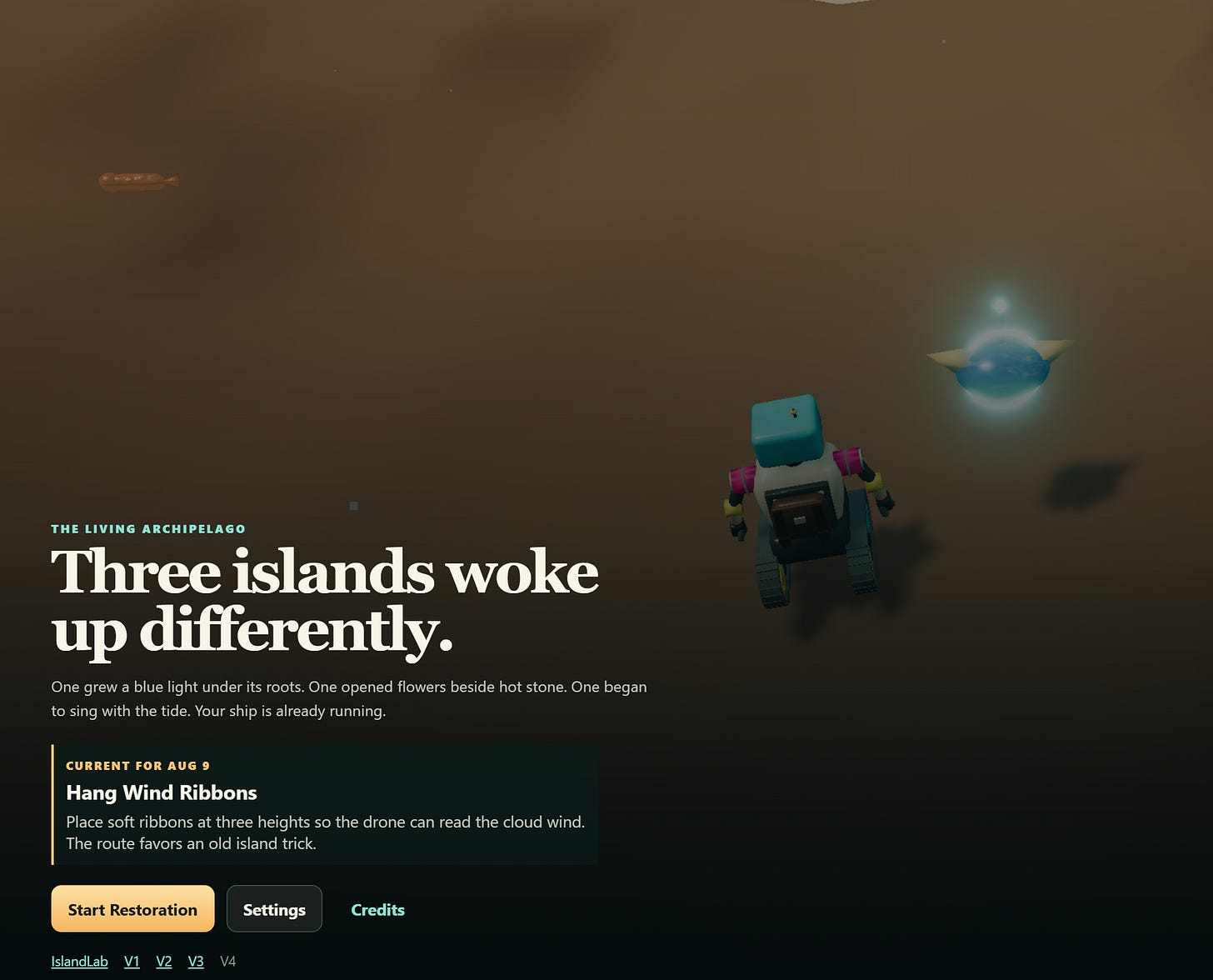
I wrote earlier this week on the Robot Lab in Island-v4. The primary focus of island v4 was character design. The secondary focus was gameplay design. It’s so easy to send AI out to build games. What I was trying to make sense of was when an AI generated game shifts from slop to game. When as a player does that feel noticeable? When class is in session.
There’s a theory of fun that suggests an unthinkable idea. The rules are that you’re having fun when you’re learning. Learning doesn’t mean in this context “pushing static information for the human to digest”. It’s the moment when experience translates to motion, and mastery is rewarded. This sounds abstract, but it’s really it.
When I first put Island-v4 island bosses in the experience there was something just off. It wasn’t just the graphics. I have a theory that graphics don’t alleviate bad gameplay. They amplify gameplay. If the core game loop is bad, then there’s no graphics that solves it. The realization hit me while at the gym.
The gym I frequent has community basketballs. These are the rejects of yesteryear. Have you ever tried playing basketball with an old basketball? The ball may bounce, but the texture of the ball is suspect. Whatever tacky grip remains of the textured surface is questionable to even put your hand on? Playing a round of basketball with such a ball had me realize: basketball is still fun with a bad basketball, but it’s better with a nicer one. Basketball without a bouncing ball doesn’t make any sense at all. The core game loop needs a bouncing ball. Even a tennis ball can be fun on the court.
Case in point, armed with a tight game loop it’s possible to pull higher quality graphics together into a trailer experience like this video. I do love this little robot!
Gameplay Design Loop Design
Each of the islands of V4 is designed to teach one specific and somewhat complex mechanic required to repair the boss of that boss’s respective island. The islandlab entry contains an entry for the specific game design ideas that are present. I won’t go into those here. Today’s substack post is about the theory of designing such game design.
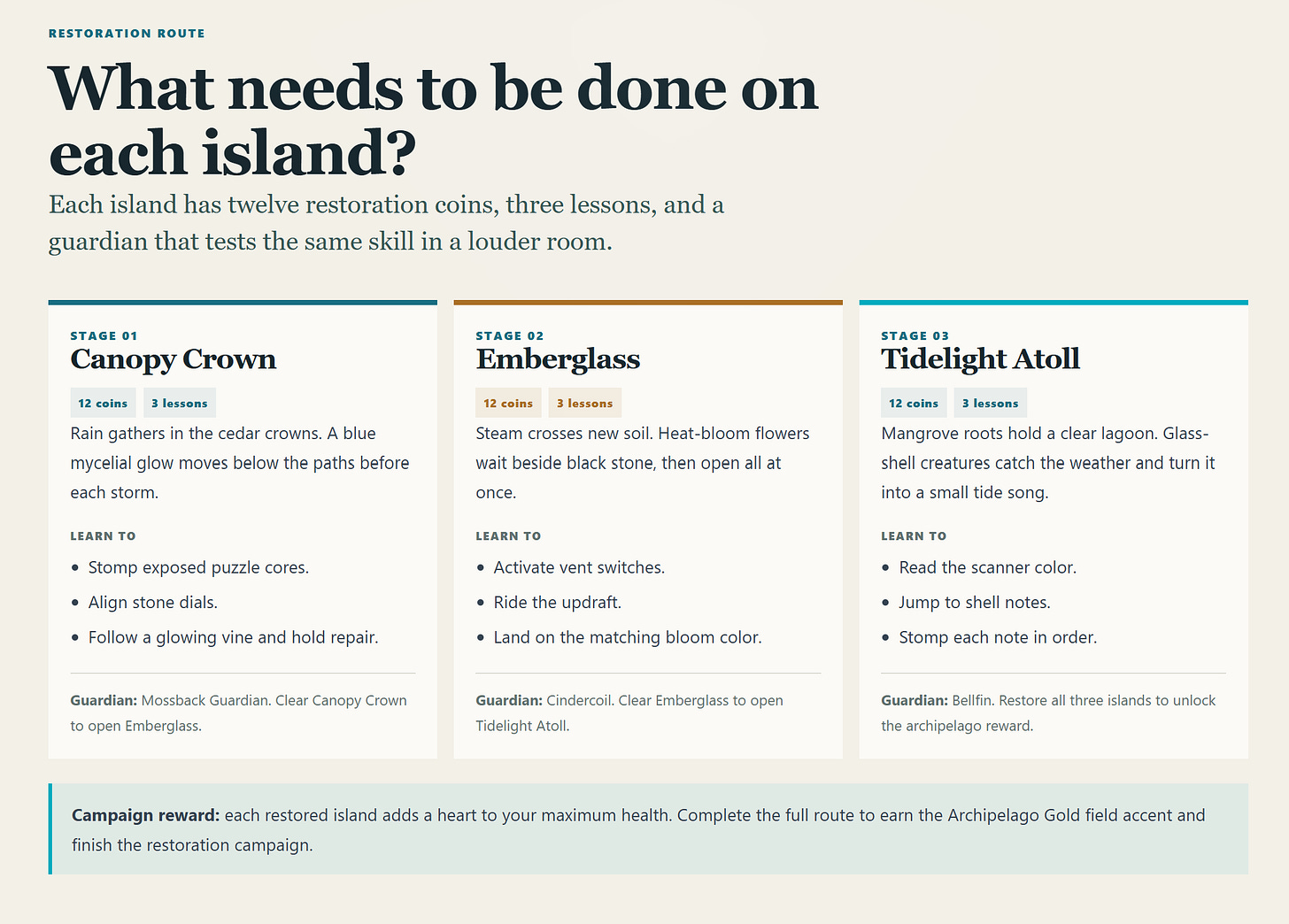
The way I broke down the design approach is to have a sandbox like area where each of the boss mechanics is taught in the course of learning about the island. Once I landed on this formula I was surprised at just how well it works. The moment you “solve” the learning of each island stage, the doorway spawns that will take you to the boss room where you can apply what you’ve learned on that island.
If you’re a deep game design expert this probably is trivial to you.
The idea of constructing stages as intentional learning environments didn’t really occur to me because so many games I play today do not lean in this direction. Instead, it’s forced tutorials or in other cases what feels like game design by committee, or by a casino (and sometimes both). The island V4 experiment is me learning game design by first principles.
One of the key lessons I learned is that it’s not about your tutorial system. Great game design is not just a function of putting tutorial objectives onto the screen. The islandv4 maps are laid out in such a way that the instinct is to move a particular way, which rewards the player with learning and insight. This is the genius of the NES Mario Bros. game. You start the game and the game loop and mechanic are taught in that opening stage, and refined over the subsequent ones.
The insight for me was when I realized the tutorial cards were not the point. Once I shifted out of that into specific gameplay design pacing, then slop-vibe nature of the AI game experience shifted. The absence of this pacing is why the Founderman game I did for the Summer into AI competition never really landed. The game visually is great, and the core game loop of shooting enemies is fun. However, there’s a pacing problem with the stages that just never sat right with me. Now I know why. It’s like getting your first exposure to Mario on a boss fight stage.
A boss can be mechanically complex without feeling unfair if the player has already built the mental model needed to solve it.
Pacing matters, and so does the environment.
The real tutorial is the environment.
The strongest teaching doesn’t feel like instruction because the level itself constrains the player toward discovery. A doorway, enemy placement, elevation change, reward, or dead end can all function as sentences in the game’s language. UI cards explain rules, and if you review literacy rates then you’ll quickly learn few people ever read them. Environment level design manifests understanding. Once the player starts predicting what the game wants without being told, an important boundary is crossed from software into game design.
The environment builds up understanding and helps guide the player into lessons they’ll need to defeat the boss. The net result is a tangible reward of mastery. The player feels like they’ve accomplished something consequential and with their own cleverness. There’s no explicit thought occurring here. This feels like programming is hitting System 2 or System 1 thinking of the brain and body. You’re presenting context for that part of the brain to work with, and not the slower parts (the order may somewhat depend). And you know? A lot of game design can be better understood if you break down System 1 and System 2 thinking and how it maps to the experience.
I had ChatGPT extract out this loop into the following arc.
Notice → Reason → Practice → Intuit → Disrupt → Reframe → Master
Game Design Notebook
Today’s product is a notebook for you to capture your own game design notes in. Spiral bound, perfect for lots of opening and closing of a notebook.
Connected work
- Island V4 Guide: Learn what changed, how the island works, and where to go next.
- Robot Lab: Open the workshop and inspect the character systems behind the island.
- Island V4 Experiment: Robot Lab: Read the earlier experiment that gave the robot a debugger, expressions, and a reason to persist.
- Island V4 Idle Animation Cycles: Watch the short loops that helped the robot feel alive.