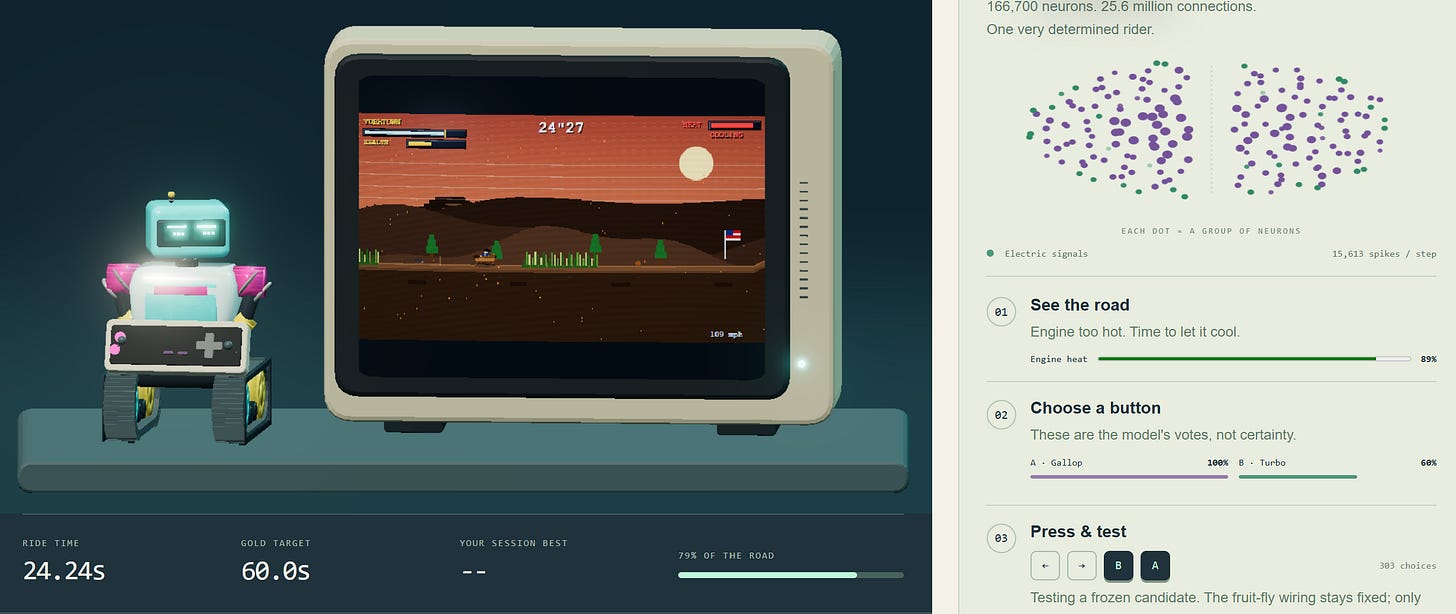
A wiring map, a simulated network, and an added controller. Illustration only. The live signals are inside the experiments.
01 Robot + gamepad02 Six robots + one ballYour job: watch the choices
Pick a spectator sport.
No lab coat required.
From the original FlyLab experiment, published September 22, 2026.
Experiment 01 / Robot Brain Arcade
A gamepad. A brain map. A very busy robot.
The Island explorer robot takes on Revere Bike across fifteen rides. Road conditions become signals. A simulated neural network responds. An added button-decider turns that activity into game controls.
Watch for: engine heat, button votes, and the switch from practice to a trained run. Enthusiasm for turbo is easier to spot when there is a meter.
Pitch illustration. Launch the experiment for the live 3D match.
Experiment 02 / The Connectome Cup
Six brains. One disputed ball.
Drosophila FC meets Real Mosca in a three-on-three robot soccer match. Each player runs its own simulated network. A trained controller reads its activity to choose moves, from a sprint to a moonwalk.
Watch for: one robot's brain panel, then its next move. Switch to the tactical camera to see where everyone else was hoping the ball would go.
Before kickoff: Soccer lists a 138.6 MB brain-map download on the first visit, cached afterward, and recommends a desktop browser. This guide loads neither simulation. Open an experiment when you are ready.
Under the tiny hood
How does wiring become a move?
A connectome is a map of connections between nerve cells. Both projects use the MaleCNS fruit-fly map in a simplified simulation. Here is the route from a game event to a button press or a turn.
01 /
Turn the world into signals.
The arcade tracks things like road conditions and heat. Soccer tracks the ball, nearby rivals, and a target position. The software feeds those signals into the network.
02 /
Let the network respond.
Simulated nerve cells send pulses through the mapped connections. The displays let you follow that activity while the robot plays.
03 /
Read out an action.
An added controller learns from examples and translates neural activity into moves. In the arcade, the brain's wiring stays fixed while this button-decider learns.
A map is not a mind. These are software experiments using biological wiring data. They do not show that a fly understands bicycles or soccer, or that the robot is conscious. The extra controller and game rules matter too.
Questions from the sidelines
Before we award the tiny trophy.
The strange part is real enough without giving the robots an imaginary inner life.
Is the robot actually a fly?
No. The arcade character is the Island explorer robot. The connection map behind its simulated network comes from a fruit fly. The body, game inputs, and action controller are software choices.
Who taught the soccer players?
The soccer project describes a controller trained offline by copying a scripted coach. That coach is switched off during matches. A formation layer still gives each robot a target position; the controller uses brain activity to choose its moves.
Where did the brain map come from?
The arcade credits MaleCNS v1.0 from Janelia Research Campus / FlyEM and collaborators, with 166,700 neurons and 25,582,938 connections. Its simulation is adapted from flybrain 0.1.0. Read the source credits, licenses, and model limits.
What should I try first?
Start with the arcade for the clearest view of signals becoming button presses. Then visit soccer, select a robot, and compare its brain panel with its movement. A moonwalk is a move. Whether it helped is a separate question.